
🔑 Quick Answer: California wine regions span 147 federally recognized AVAs, from Mendocino’s redwood coast to the inland valleys near San Diego. The 10 worth building a trip around are Napa, Sonoma, Carneros, the Santa Cruz Mountains, Monterey, Paso Robles, Santa Barbara, Malibu, Mendocino, and the Sierra Foothills. They are not interchangeable.
Key Takeaways
- California makes 81% of all wine in the United States, across 147 AVAs, and the 10 regions below are the ones worth structuring a trip around.
- Napa is the famous answer and Sonoma is usually the better one for a week, because it is bigger, more varied, and less reserved about how it pours.
- Plan two or three tastings a day at most, and remember that tasting rooms close by 5:00 PM, earlier than almost any other attraction in the state.
- A guided day with a private driver runs about $700 for eight hours before tasting fees, and tasting fees themselves run $40 to $150 a person.
California wine regions produce 81% of the wine made in the United States, so the hard part of planning a trip here isn’t finding good wine. It is choosing where to stand while you drink it. If it is your first time in California wine country, start with our California wine tasting tips.
Napa is the answer everyone reaches for first. Sometimes it is the right one. Often it is not, and the difference between a trip that works and one that feels like a lot of driving comes down to picking the region that matches how you actually like to spend a day. This is that decision, laid out.
Why Trust Us in California Wine Country
I am a born-and-raised Californian. I lived in San Francisco for almost 10 years; I live in the Eastern Sierra now, and California wine country is the region Salt & Wind plans more trips to than anywhere else on earth. I am a Le Cordon Bleu-trained chef and cookbook author, and I hold a WSET Level 2 certification in wine, which underpins everything below about what is in the glass.
I have tasted at more than 100 California wineries. Salt & Wind has been planning food and wine trips since 2014 and has built more than 50 California wine trips, and every rate in the cost section below comes from a trip we booked this year rather than an estimate. The order these regions appear in is not a ranking. It is the order I would introduce them to somebody who had never been.
Who this guide is for: couples and small groups of friends planning a first or second trip to California wine country, with a week or less and a decision to make about where to point the car. If you are traveling with children, start in Sonoma or the Sierra Foothills, where there is something to do between tastings.
The 10 California Wine Regions, Compared
Here is the whole decision in one place. Read down the “Best for” column first, then go to the section that matches.
| Region | Drive from | Known for | Signature grape | Best for |
|---|---|---|---|---|
| Napa Valley | 1 hr 15 min to 2 hrs, SFO | Cult Cabernet, Michelin dining, 240 wineries | Cabernet Sauvignon | A first trip, or a milestone |
| Sonoma County | 1 hr 15 min to 2 hrs, SFO | 500+ wineries, 50+ grape varieties, farm-to-table | Pinot Noir | Staying a full week |
| Carneros | About 1 hr, SFO | Sparkling wine and cool-climate whites | Chardonnay | Splitting Napa and Sonoma |
| Santa Cruz Mountains | About 45 min, San Jose | Redwoods, mountain roads, Old World styles | Pinot Noir | A day trip with a view |
| Monterey | About 2 hrs, SFO | The most underrated in the state | Pinot Noir | Avoiding crowds |
| Paso Robles | About 2 hrs from Santa Barbara | Rhône blends and old-vine Zinfandel; 80% red | Syrah, Zinfandel | Walk-ins and value |
| Santa Barbara | 1 hr 30 min to 2 hrs, LAX | The urban Funk Zone plus rural AVAs | Pinot Noir, Syrah | Wine country without a car |
| Malibu and LA | In Los Angeles | 50+ vineyards within reach of the city | Cabernet Sauvignon | A half day out of the city |
| Mendocino | About 2 hrs 30 min, SFO | Organic and biodynamic pioneers, redwoods | Pinot Noir | A road trip |
| Sierra Foothills | About 1 hr, Sacramento | Gold Rush towns and old vines | Zinfandel | Pairing with Yosemite or Tahoe |
One drive worth planning around. Sonoma to Santa Barbara on the full Big Sur route is about eight and a half hours of driving, and nobody drives Big Sur without stopping, so in practice it is a 10 to 12 hour day. Our clients take the 101 south and drop onto Highway 1 near San Luis Obispo instead, which is about six hours and 15 minutes with stops and still gives you real coastline. Highway 1 through Big Sur is also subject to slides and closures, so confirm the road is open before committing to it.

Napa Valley: For World-Famous Wines
Napa Valley is California’s most famous wine region, a 30-mile valley about an hour and a half north of San Francisco with 240 wineries, Michelin-starred restaurants, and Cabernet Sauvignon as its calling card.
This 30-mile-long valley is home to Michelin-starred chefs and replica Tuscan castles, and it is a classic choice for a first California wine trip. Although Napa is famous worldwide, it produces only 4% of California’s wine.
Where to stay: Bardessono in Yountville ran $800 a night in mid-September, and it is contemporary rather than classic, which is worth knowing if you pictured a Tuscan villa. Yountville is the most restaurant-driven town in the valley, so it suits people who plan their day around dinner.
Sonoma County: For Farm-To-Table Heaven
Sonoma County is the largest California wine region by winery count, with more than 500 wineries growing over 50 grape varieties across microclimates that run from coastal cliffs to inland hills.
Though the region grows more Pinot Noir than any other area in California, it grows far more than that: Cabernet Sauvignon, Chardonnay, Merlot, Zinfandel, and Sauvignon Blanc all do well. The best-known AVAs worth visiting are the Russian River Valley, Dry Creek, Alexander Valley, Knights Valley, and Chalk Hill. Leave time for the towns of Healdsburg and Sonoma, the local food, the Sonoma cheese trail, and everything else there is to do in Sonoma Valley.
Where to stay: Farmhouse Inn in Forestville ran $650 a night in mid-September and was the best value we found in all of wine country that week. The catch is real: you need a car or a driver to leave, and the rate more than doubles in the following window.
Carneros District: For Crisp, Cool-Climate Wines
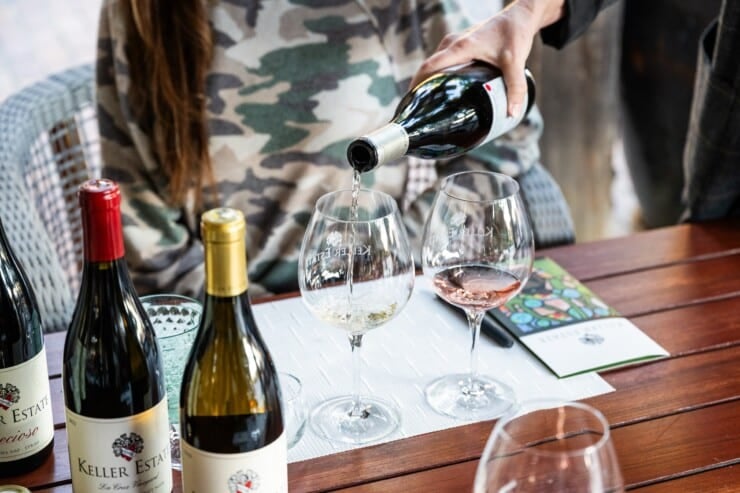
Los Carneros sits at the southern end of both Napa and Sonoma, and its cool, foggy microclimate makes it California’s home for sparkling wine and cool-climate Chardonnay.
If you cannot decide between Napa Valley and Sonoma County, this is how you get both. The climate also suits sophisticated Merlot, Pinot Noir, and Syrah, and it is where you will find top sparkling producers like Gloria Ferrer, Domaine Carneros, and Chandon, alongside high-end Pinot houses like Ram’s Gate.
Santa Cruz Mountains: Vistas And Vines
The Santa Cruz Mountains AVA is the most dramatic setting of any California wine region, with vineyards tucked among redwoods and winding mountain roads about 45 minutes from San Jose.
You will find distinctive, Old World-leaning wines in a genuinely remarkable setting, across an AVA that spans three counties. One of our favorite wineries here is Bonny Doon, whose French-inspired wines like the Vin Gris and the Picpoul pair beautifully with the regional farm-to-table cooking and local seafood.
Monterey: Vines, Pebbles, and Pines
Monterey is one of California’s most underrated wine regions, better known for lettuce than Pinot Noir, and its cool coastal climate produces both.
Monterey winemaking didn’t really begin until the late 1950s, when the Santa Clara and Livermore Valleys were urbanizing, and UC Davis research showed that fine wine could come from cooler coastal climates. Notable vineyard areas include Carmel Valley, Arroyo Seco, the Santa Lucia Highlands, and Chalone. Look for producers like Caraccioli, Talbott, and Scheid. Our Monterey wine tasting guide has the full picture, and what is grown in Monterey explains the rest of the valley.
Paso Robles: For Red Rhône Lovers
Paso Robles is California’s Rhône country, where 80% of the wine made is red, and the geology resembles France’s Rhône Valley closely enough that the comparison is more than marketing.
Grapevine cultivation in San Luis Obispo County dates back to the Spanish missionaries. Our Paso Robles wine country guide goes deeper, and what to taste in Paso right now keeps up with the producers. Today, you will find southern Rhône-style wines alongside Bordeaux blends, Cabernet Sauvignon, and Zinfandel across rolling hills protected from marine fog and coastal winds.

Santa Barbara: For Laidback Luxe Wines
Santa Barbara County is the one California wine region you can taste in without a car, because the Funk Zone puts more than a dozen tasting rooms within walking distance of the beach.
You can explore this region’s wine both inside and outside the city limits, with the urban wine trail downtown and the rural AVAs beyond it. Make time for local food at one of the weekly Santa Barbara farmers’ markets, and our Santa Barbara food lover’s itinerary covers the rest.
Where to stay: The Ritz-Carlton Bacara ran $800 to $1,200 a night depending on the week. It is on the water, and the trade-off is that Santa Barbara itself is a 20-minute drive each way.
Los Angeles and Malibu: Wineries Near Hollywood
Los Angeles County has more than 50 vineyards, nearly all in coastal Malibu, making it the only California wine region you can reach on a half-day trip from a major city.
Follow the Malibu Wine Trail, or take a guided tour that strings together Malibu, Rodeo Drive, and the Santa Monica pier. While you are in the city, our guides will show you the best dessert in Los Angeles and the boutiques worth a detour.
Mendocino: Sip Amongst The Redwoods
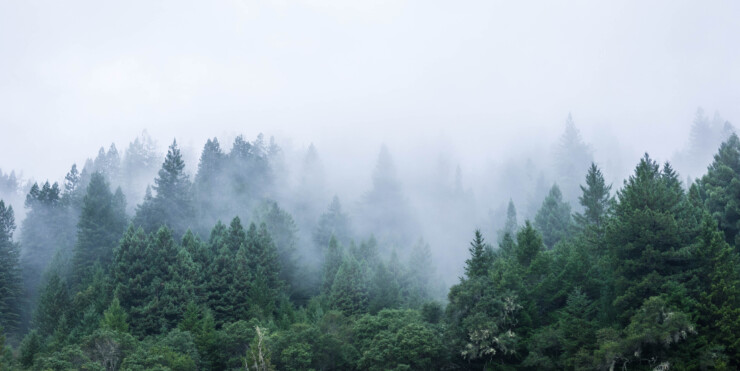
Mendocino County is California’s northernmost coastal wine region and its organic and biodynamic pioneer, growing Pinot Noir, Cabernet Sauvignon, and Chardonnay under redwoods and fog.
Dozens of other varietals grow here too, thanks to the county’s diverse climate and geography. As outdoor lovers, this is one of our favorite places to road trip in California, and the winery quality is a bonus.
Sierra Foothills: For Gold Country Vibes
The Sierra Foothills AVA runs along the western edge of the Sierra Nevada through California’s Gold Country, and its old-vine Zinfandel is the best reason to stop on the way to Yosemite or Tahoe.
The AVA starts in Yuba, Placer, and El Dorado counties in the north and ends in Mariposa County in the south, taking in quaint gold-mining towns and rolling hills along the way. Look for top-quality Zinfandel in Amador County, plus Sangiovese and Barbera, and read our deeper dive into Sierra Foothills wine. If Yosemite is on the same trip, Mariposa is the gateway town, and we have a guide to where to stay near the park.
What a California Wine Region Trip Actually Costs
Nobody publishes this, and we can, because these are rates from a client trip we booked for September 2026. This is one week for two people in Sonoma, Napa, and Santa Barbara.
| What | Real quoted cost | Notes |
|---|---|---|
| Private car, SFO to Healdsburg | $645 | About two hours in Monday evening traffic. An SUV came in at $900. |
| Private guide and vehicle, full day | $700 | Covers an eight-hour day. Beyond that, roughly $100 an hour. |
| Tasting, small family winery, Dry Creek Valley | $40 per person | |
| Tasting hosted by the owner, with food, Dry Creek | $95 per person | |
| Cave tour and sparkling tasting, Calistoga | $100 per person | |
| Wine and food pairing with lunch, Napa | $185 per person | |
| Rental car, four days, Santa Rosa to LAX | $776 to $794 | Sedan and SUV respectively. |
| Farmhouse Inn, Forestville, mid-September | $650 a night | |
| Bardessono, Yountville, mid-September | $800 a night | |
| Ritz-Carlton Bacara, Santa Barbara, mid-September | $800 to $1,200 a night |
For a midrange week, not counting airfare: budget $400 or more for a rental car, $350 and up a night for lodging, and about $700 for a week of meals for one person, plus tasting fees on top. Luxury lodging in Napa, Sonoma, Santa Barbara, or Big Sur regularly runs $800 to $2,000 a night in high season.
Tasting fees add up faster than people expect. Budget $40 to $150 per person per winery. They are often waived with a purchase, which changes the arithmetic if you were going to buy anyway.
What Not to Do in California Wine Country
Every item below is a correction we have made to a real client itinerary, and most of them come from the same mistake: treating a tasting day like a sightseeing day.
Don’t schedule more than two or three tastings in a day. Three is the ceiling, two is better, and the third one is the one nobody remembers.
Don’t assume you can taste late. Tasting rooms usually close by 5:00 PM and sometimes 4:30, which is earlier than almost anything else in California. Wine days end sooner than people plan for.
Don’t count on Monday or Tuesday. Many wineries and small-town restaurants close both days. In a small town that can mean the one good restaurant is dark.
Don’t do Napa and Sonoma in the same day. They sit close together on a map, and the point of each is different. You will spend the day proving it in the car.
Don’t drive between tastings. Wine country law enforcement takes this seriously, and a designated driver or a hired one is the reason our clients get to taste at all.
Don’t skip the reservation. In Napa, Sonoma, and Paso Robles, most wineries now require one. Walk-ins still exist, and they are the exception rather than the rule.
Don’t rely on your phone. Coverage is unreliable in exactly the places you will want it: Highway 1 through Big Sur, the Sonoma Coast, and the back roads of the Santa Ynez Valley. Download offline maps first, and read our essential California road trip tips before you set off.
How We’d Sequence a First California Wine Trip
How long you have decides how many regions you can reasonably see, and the honest answer is fewer than most people plan for. Two shapes work.
Three days, in and out of SFO. Day one is Carneros for sparkling and a soft landing. Day two is Napa, with two tastings and a long lunch. Day three is Healdsburg and the Russian River Valley, then back to the airport. Sonoma town is about 11,000 people and Healdsburg about 12,000, and both are walkable end to end in 15 minutes, which is why we base people in a town rather than out among the vines.
Seven days, SFO to LAX. Two nights in Sonoma, two in Monterey or the Santa Cruz Mountains, three in Paso Robles and Santa Barbara. The drive is the argument for California: you taste four climates in a week.
The version we would talk you out of: Napa, Paso Robles, and Santa Barbara in four days. That is most of the state’s length, and you will remember the 101.
The Part That Is Hard to Do Alone
California is the easiest wine country in the world to visit and one of the harder ones to visit well. The tasting rooms that take walk-ins are, by definition, the ones with room, and the small allocation-list producers people come home talking about don’t have a booking page.
That is the part we do. We work with a private guide in Sonoma who spent years inside one of California’s benchmark Pinot Noir houses and can still get clients a tasting that is normally held for allocation members. We know which owner in Dry Creek Valley will pour for you in her own garden, and which Calistoga cave tour is worth the hundred dollars a head.
If you would rather somebody else made the introductions, book a complimentary Discovery Call and a Salt & Wind planner will map out a California wine trip worth taking, plus a quote to make it happen. You can also browse our California wine country travel guide or our California vacation planning services.
Frequently Asked Questions
Napa, if you want the famous version and have three days. Sonoma, if you have a week. Napa is tighter, more polished, and easier to do badly, because the marquee names book out and the tasting fees are the highest in the state. Sonoma is larger, more varied, and more relaxed about how it pours, which makes it the better first week for most people.
Temecula is Southern California's largest wine region, with around 50 wineries about an hour from San Diego, and it is the right answer for anyone in Southern California who wants wine country without getting on a plane. It isn't in our 10 because this list focuses on regions worth traveling to California for, and Temecula's real strength is its proximity rather than what is in the bottle. If you are in Los Angeles or San Diego, go.
Three days for one region, a week for two or three. Three days give you a soft landing: one guided day and one town. A week makes the drive worth it, because California's regions are hundreds of miles apart, and the point of a longer trip is tasting four climates rather than four wineries.
Santa Barbara is the one that works. The Funk Zone puts more than a dozen tasting rooms within walking distance of the train station and the beach, and the Pacific Surfliner gets you there from Los Angeles. Everywhere else on this list needs a car or a driver.
California wine history started in 1769 at Mission Basilica San Diego de Alcalá. Franciscan Father Junipero Serra led the mission's founding, a trail that eventually ran 600 miles north to Sonoma, and each site was planted with vines of the grape we now call the Mission grape.
The commercial industry did not start until 1834, when Jean-Louis Vignes planted vineyards near modern-day Los Angeles. After the gold rush in 1849, the industry took off, and by 1919 the state had more than 1,000 wineries. Prohibition set it back, and the 1976 Judgment of Paris brought California wine worldwide recognition.
Like all US wine regions, California is organized by federally recognized growing regions called American Viticultural Areas, or AVAs. The entire state and each county count as an appellation of origin. From there, California has four very large AVAs that overlap many smaller ones: North Coast, Sierra Foothills, Central Coast, and South Coast. The North Coast, for example, includes Mendocino, the Russian River Valley, Sonoma Valley, and Napa Valley. AVAs that don't fit into those four are grouped under the unofficial terms Far North, Inland Valley, and Southern.
As of 2022, California has 147 total AVAs. On labeling: to list an AVA on a wine label, at least 85% of the grapes must have been grown in that AVA. To put a county name on a label, that number is 75%. Wine labeled "California," or with any California AVA, requires that 100% of the grapes grew in the state.
While all those terms are regulated, "wine country" is not. As Californians, we say "wine country" whenever we are heading to one of the corners of the state, whether that is Santa Cruz, Sonoma, Paso Robles, or Temecula, where the focus is on winemaking. When most people say it, though, they mean the area north of San Francisco where Sonoma Valley, Napa Valley, and the Russian River Valley sit.
From the misty northern coast to the arid southern foothills, more than 100 grape varieties grow in the Golden State. But the vast majority of California's vineyard acreage is planted to just eight wine grapes: Cabernet Sauvignon, Chardonnay, Pinot Noir, Zinfandel, Merlot, Sauvignon Blanc, Pinot Gris, and French Colombard. The last of those will surprise you, and you will almost certainly never be poured a glass of it. French Colombard is a Central Valley workhorse grown for bulk wine and brandy, and it sits eighth on the list with nearly 15,000 acres. The grape you are most likely to taste that is not on this list is Syrah, ninth at around 13,500 acres.
California's largely arid, sunny, mild climate is similar to the Mediterranean, which makes it ideal for full-bodied reds. But regions along the ocean, like Mendocino, Sonoma, and Santa Barbara, get the fog we call "refrigerated sunshine" around here, and those areas do beautifully with cooler-climate varieties including Pinot Noir.
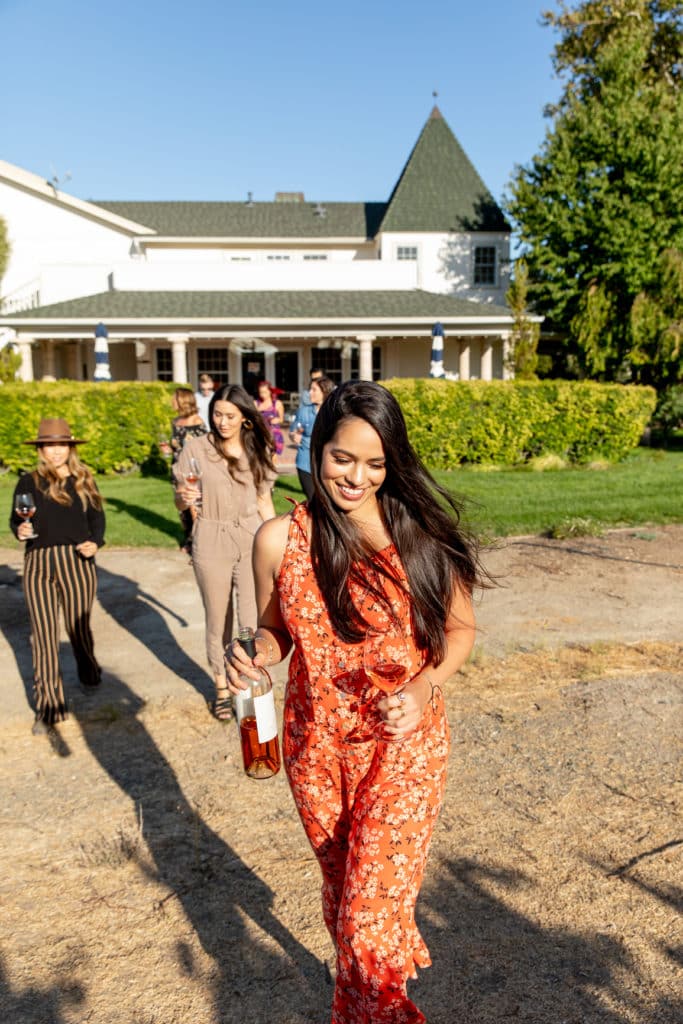
Plan a Trip to California Wine Country
While it’s easy to dream of a land of grapevine-covered hills, sunshine, and endless wineries, there are definitely some logistical considerations to take into account, too.
Planning Winery Tastings
Almost every winery is going to have different policies when it comes to reservations. In the more popular wine regions like Napa, Sonoma, and Paso Robles, the majority of the wineries have started requiring reservations in advance so definitely have a plan.
Even so, other wineries do allow walk-ins. There are typical tours at several different times throughout the day at wineries.
You’ll want to think about which wineries you want to tour versus those you just want to enjoy a tasting to make the most of it.
We suggest you don’t schedule more than two or three tastings a day so that you aren’t rushed and you can leave time for exploration.
How To Drive In Wine Country
Planning a road trip through California wine country? If so, check out these essential tips for a California road trip.
And it’s best to have a designated driver for each day you’ll be wine tasting. If you prefer to hire a driver, go ahead and reach out to us and we’ll help you arrange that.
California Road Trip Planner
Did you know we’re also a boutique travel agency that specializes in California vacation planning? If you’re looking to plan a trip to California, our California vacation planning services are here to help you plan your perfect itinerary.
Photo Credit: Photos by Jayme Burrows, Jesse Murrow, and Trinette Reed
Sponsored Content: This post was brought to you by California Grown and Discover California Wines, but all content, ideas, and words are our own. Thanks for supporting these sponsors who allow us to keep Salt & Wind Travel up and running.

1 thought on “California Wine Regions: The 10 Best to Visit”
Why isn’t Temecula wine region mentioned? Great wines!!!!!!!!