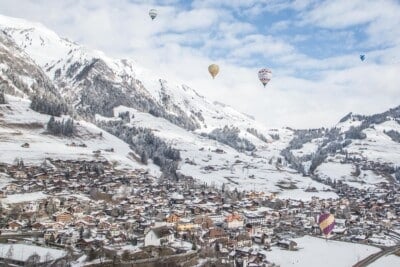
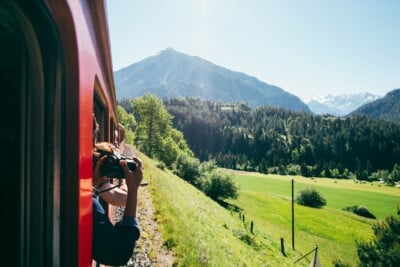
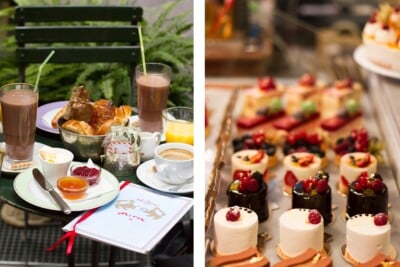
Our Switzerland travel guide is written for the traveler who comes for the Alps and stays for the food. This is a country of mountainside fondue, Alpine cheese, world-class chocolate, and wines so rarely exported that they’ll be new to almost everyone. Add some of the most scenic train rides on earth, and you have a trip that rewards slowing down.
This guide covers where to go across Switzerland’s three language regions, when to visit, and how to plan a trip centered on food, wine, and mountain scenery. Every recommendation comes from real-time, on-the-ground experience, not a guidebook.
Why Trust Us
Team Salt & Wind knows Switzerland from the inside. We’ve worked directly with Switzerland Tourism, producing marketing videos for the country, and every member of our team has traveled here, from Zermatt, Grindelwald, and Interlaken to Zurich, Geneva, Ticino, and Gstaad. We’ve skied and gone sledding, hiked and tasted wine, and logged plenty of slow days on the lakes. We also hold WSET Level 2 wine credentials, which comes in handy in a country whose best bottles almost never leave its borders.
We plan Switzerland trips year-round, sending clients for ski season in winter and lakes and mountains in summer. Some of our favorite itineraries combine the Valais with France, pair Ticino with Italy, or explore the whole country by train. Every hotel, restaurant, and experience we recommend is one we’ve vetted in person or booked for clients, and we design fully custom itineraries rather than resell packages.
One note: Switzerland’s mountain seasons, train timetables, and hours shift through the year, so confirm the details close to your trip, or let us do it for you.
Switzerland Region-by-Region
Switzerland changes language, food, and mood as you cross it, and that’s the fun of planning a trip here. We organize around its three cultural regions, because a week in Ticino feels nothing like a week in Zurich. Here’s how each one is different.
French-Speaking Switzerland (Romandy) wraps around Lake Geneva, from Geneva and Lausanne to the vineyard terraces of the Valais. French elegance meets Swiss precision here, with lakeside castles, chic cities, and Michelin-starred dining.
Italian-Speaking Switzerland (Ticino) feels like the Mediterranean tucked into the Alps: palm-lined lakes, sunny piazzas, and plates of risotto, polenta, and Merlot. It’s the country’s most relaxed corner.
German-Speaking Switzerland is the largest region, home to Zurich, Lucerne, Bern, and Basel, as well as classic Alpine resorts like Zermatt. Medieval old towns sit beside modern art museums, with mountains never far away.
Sample Switzerland Itineraries
The best Switzerland trips lean on the country’s superb trains and go deep in one or two regions. A few routes our travelers love:
- Scenic rail sampler: the Glacier Express and Bernina Express, linking Zermatt, the Alps, and Ticino.
- Alps & lakes: Lucerne, Interlaken, and Zermatt for mountains, hiking, and fondue.
- Lake Geneva & the Valais: Montreux, Lausanne, and wine tasting through the terraced vineyards.
- Ticino escape: Lugano and Locarno for a sunny, Italian-flavored few days.
Each works on its own or as a building block for something longer. We tailor the pace, the lodging, and the rail passes to how you like to travel.
Lorem ipsum dolor sit amet, consectetur adipiscing elit. Ut elit tellus, luctus nec ullamcorper mattis, pulvinar dapibus leo.
Swiss Food And Wine
Swiss cuisine is far more than fondue and chocolate, though both are worth savoring. From the creamy cheeses of Alpine pastures to the elegant Pinot Noirs of the Valais, the food reflects the country’s geography and its three cultures.
Want a taste before you go? Explore our Swiss recipes collection.
Lorem ipsum dolor sit amet, consectetur adipiscing elit. Ut elit tellus, luctus nec ullamcorper mattis, pulvinar dapibus leo.
Switzerland Travel Frequently Asked Questions
When is the best time to visit Switzerland?
Summer (June to September) is best for hiking, lakes, and mountain views, while December to March is peak for skiing. The shoulder months of May and October are quieter and cheaper, though some high-altitude lifts and trails may be closed.
How many days do you need in Switzerland?
Plan on at least five to seven days to pair a couple of regions without rushing, for example the Alps plus Lake Geneva. Ten days lets you add Ticino or a stretch of scenic rail at a relaxed pace.
Is Switzerland expensive, and how do you save?
Switzerland is one of Europe’s pricier destinations, but a Swiss Travel Pass covers most trains, buses, boats, and many museums, which adds up fast. Lunch specials and guesthouses also stretch a budget.
Do you need a car in Switzerland?
Not usually. The train, tram, boat, and bus network is among the most efficient in the world and reaches almost everywhere, including mountain villages. Most travelers skip the car entirely.
Which part of Switzerland should I visit?
It depends on the trip you want. Romandy for wine and Lake Geneva, Ticino for a sunny Mediterranean feel, and German-speaking Switzerland for the classic Alps and cities. Many trips combine two.
Travel Planning Resources
You’ve been inspired. Now let us do the heavy lifting. Book a complimentary Discovery Call and a Salt & Wind travel planner will map out a trip worth taking, plus a quote to make it happen. No cookie-cutter itineraries, no tourist traps.
- Apartments: Use code SaltandWindTravel/AM when booking apartment stays with Plum Guide
- Tours: Book in-depth tours with Context Travel
- Shop: See our favorite travel essentials in our Amazon store.