🔑 Quick answer: To help kids beat jet lag, get them into natural morning light, shift to local meal and sleep times the moment you land, keep naps short and early (or skip them for ages 3+), and keep the first 72 hours low-key. Expect the first three nights to be hardest; most kids adjust within three to five days.
Key Takeaways
- Kids feel jet lag more quickly and more intensely than adults: expect mood, sleep, and appetite swings, especially in the first 72 hours.
- The fixes that actually move the needle: morning light, shifting to local time immediately, controlled (or no) naps, hydration, and a calm, boring night routine.
- Most kids adjust within three to five days; lower your expectations for the first few nights and protect at least one parent's sleep.
How to help kids with jet lag is a question I’ve been answering for more than a decade, first for my Italy travel clients as they set off on their trips, and then for myself as a new parent planning my first transatlantic life with an 8-month-old.
Here’s the good news: while a new time zone can seem daunting with little ones, your trip can go better than you’ve imagined. Jet lag is manageable once you understand what’s happening and how to respond. Below, I’ll walk you through what to expect, the tactics that actually work, what families should know before they fly, and the questions parents ask us most.
Why Trust Us When It Comes to Jet Lag With Kids
I lived in Italy for 12 years and have split my time between Italy and the United States for the past four years. My children have traveled internationally with a time difference of at least nine hours, at least once a year for their entire lives, more than 30 transatlantic crossings in all.
I’ve experienced it all, from the wide-eyed toddler at 2:00 a.m. and the overtired preschooler melting down in the middle of a piazza, to the jet-lagged elementary schooler who has to be picked up from school the week we return. I know intimately how hard a new time zone can be for kids and parents alike.
Helping families through those first jet-lagged days is part of what we do at Salt & Wind Travel. We plan more than 50 family trips to Europe a year, and these are the same tactics we walk clients through before they fly. When a trip needs a gentle first 72 hours, we build in flexible, low-key days and lean on local partners who understand what it’s like to travel with children.
One honest note before we dive in: I’m a parent and travel planner, not a doctor. What follows is what has worked for our family and our clients, alongside guidance from pediatric sleep experts, which I’ve linked throughout. Always check with your pediatrician about your own child’s needs.
What Parents Should Know About Jet Lag in Kids
In short: kids feel jet lag more intensely than adults. The first 72 hours are the hardest, and a handful of deliberate habits- light, timing, naps, and hydration- shorten the adjustment. It’s important to remember that jet lag is not simply “being tired.” It is a physiological mismatch between your internal body clock and the time zone you are currently in.
When you cross multiple time zones (especially five or more), your circadian rhythm doesn’t instantly reset. Your circadian rhythm is the internal 24-hour clock that tells your body when to feel awake and when to feel sleepy, and it stays on your home schedule even as the sun, meal times, and social expectations around you have already moved on. For the underlying science, the Sleep Foundation explains how crossing several time zones desynchronizes the body clock from local daylight and mealtimes.
Here are the key things families should understand before they go:
Kids are more sensitive to sleep disruption than adults.
Children’s nervous systems are still developing, and sleep plays a critical role in emotional regulation and physical growth. When sleep is disrupted, the effects are often more immediate and intense than what adults experience. A tired adult might feel foggy, while a tired child might melt down over the smallest inconvenience.
Additionally, kids rely heavily on routine to feel secure. Sleep and meal timing anchor their sense of predictability. When that anchor shifts suddenly, behavior often reflects that instability. You might find that little kids and toddlers suffer from upset stomachs, sudden impulsivity, and sleepless nights.
Eastbound travel is usually harder than westbound.
Traveling east (for example, from the U.S. to Europe) requires the body to “lose” hours. That means going to sleep earlier than your internal clock feels ready for, which is biologically more difficult. Most people find it easier to stay up later than to fall asleep earlier.
For kids, this often shows up as wide-awake energy at bedtime in Europe, followed by wanting to sleep in late when it would be “night” back home. Westbound travel typically feels gentler because staying awake a little longer aligns better with natural rhythms.
In Europe, I use this to our advantage. On days 2 to 4, we let the kids stay up later than usual (which works with restaurant hours, too). Then, we sleep in later in the morning than we would back home. After a couple of days, we start moving back the bedtime and morning wake-up times until we’re back where we want to be. It looks like this:
- Arrival day: Everyone to bed early
- Day 2 to 3: Stay up until 10 pm, wake up in the morning around 9 to 10 am
- Day 4: Stay up until 9:30 pm, wake up around 8:30 to 9 am, and so on for the following days until bedtime is back to being around 8:30 (which works for us, but you may opt to keep it late the whole trip, especially in countries like Spain).
The first 72 hours are most intense
The first three days are when sleep disruption, mood swings, and changes in appetite are most noticeable. Many parents panic during this window, assuming the entire trip will feel this way. But if you’re strategic with your jet lag coping, it will not!
When planning your trip, consider the first 72 hours your “low-key” days. Plan for flexible activities like spending time in open spaces, playgrounds, walking tours with flexibility (like DIY ones that we can create for you), and built-in snack breaks can make all the difference.
Overscheduling makes everything worse.
Jet lag combined with heavy sightseeing is a recipe for tears. Museums, crowded public transportation, and long restaurant meals are demanding even for well-rested kids. Add exhaustion, and coping skills disappear, and even the most easy-going kiddos become feral.
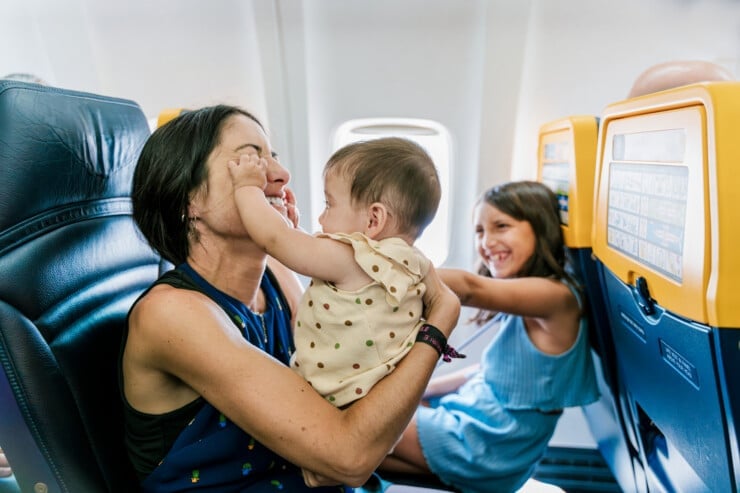
How Jet Lag Affects Kids
Sleep Disruption
Sleep disruption is the most obvious and immediate effect of jet lag. Children may wake at 3 or 4 AM, fully alert, as though the day has begun. Others may struggle to fall asleep at bedtime, even though they appear exhausted, and then sleep late into the morning.
Some children fall asleep easily but wake repeatedly during the night. Others wake once and cannot fall back asleep at all. These disruptions can last several days and tend to peak around the second or third night after arrival. Luckily, I find that the first day is the easiest; everyone is so tired from the overnight flight that they usually sleep long and hard the first night.
Emotional Dysregulation
Jet lag lowers emotional resilience dramatically. Children who are normally easygoing may become unusually sensitive or reactive. Small disappointments or strange new foods may feel enormous and overwhelming when a child is overtired.
You may see increased clinginess, tears over minor frustrations, or difficulty transitioning between activities. Take heart because this is not misbehavior; it is neurological fatigue. One thing that has always helped us during this phase of jet lag is maintaining our bedtime routine at home (bath, book, bed, for example).
Appetite Changes
Hunger cues are regulated by the same internal clock that controls sleep. When that clock is disrupted, appetite follows. Some children refuse meals entirely, while others demand food at odd hours. They may want big meals, or start eating like a bird.
Both are normal and can be helped by encouraging them to drink plenty of water throughout the day. Sounds strange, but keeping them hydrated helps avoid disruptions at night, since hunger and thirst cues can feel similar.
Physical Symptoms
Jet lag can cause mild physical discomfort in some children. Headaches, stomach upset, constipation, or general sluggishness are not uncommon. Dehydration from flying can intensify these symptoms.
Children are not always able to articulate that they feel “off.” Instead, it may show up as irritability or lethargy. Be on the lookout for dehydration and try to keep water bottles filled up and handy.
The Domino Effect
One poor night often leads to a challenging day. A challenging day can leave you overtired by evening. Overtiredness makes it harder to fall asleep, and, well, you know the drill. The cycle seems to be never-ending and can overwhelm parents as well.
Understanding this domino effect helps you intervene early. Preventing daytime over-tiredness can dramatically shorten the adjustment period.

Jet Lag by Age
Jet lag hits differently depending on your child’s age, largely because sleep needs and nap patterns change so much in the early years. The AAP and the Sleep Foundation both publish helpful sleep-by-age guidance: see how many hours of sleep kids need and the Sleep Foundation’s overview.
| Age Group | What to Expect | What to Do | Typical Adjustment |
|---|---|---|---|
| Babies (0–12 months) | Scrambled feeds, night waking, and general fussiness. They can't "push through"—they adjust on their own clock, so patience beats strategy. | Get outside together in morning light, nudge feeds toward local mealtimes, offer full feeds day and night, and keep the room dark at night. Follow their cues. | About 3–5 days (roughly a day per time zone) |
| Toddlers & Preschoolers (1–5) | The hardest group: big emotions, meltdowns, nap chaos, and the dreaded 4 a.m. wake-up. | Lots of morning light and activity, cap naps at 60–90 minutes and keep them early, hold local mealtimes and bedtime, allow a slightly early bedtime on day one only, and keep the first days low-key. | About 4–6 days (trends to the longer end) |
| School-Age Kids (6–12) | Groggy and moody, slow to fall asleep or waking too early—but old enough to follow a plan. | Explain the plan, prioritize morning daylight and movement, skip naps, hold local mealtimes and bedtime, and keep them hydrated. | About 3–5 days |
| Teens (13+) | Night-owl body clocks make eastbound brutal; they'll want to sleep all day. | Get them into morning light, block long daytime sleep, hold the local schedule, limit screens at night, and hydrate. | About 4–6 days |
Before You Land: How to Set Up an Easier Adjustment
A lot of jet lag is won or lost before you touch down, so this is where our planning brain kicks in. When we build family trips, we look at flight timing first: an overnight flight that lands in the morning gives you a full day of daylight to start resetting, while a daytime arrival can mean a rough evening when everyone is running on empty.
If the budget allows, premium economy is worth it: the extra recline and space genuinely help everyone arrive less wrecked. And if the time change is big or your kids are very young, a one-night stopover to break the journey in half can take the edge off the whole trip.
On the plane, keep everyone hydrated, offer simple familiar food over the rich airline meal, and let them sleep if they will, but don’t fight for a full night’s sleep that isn’t coming. Full honesty: my own kids refuse to sleep on a plane no matter what I try, so I plan the first days assuming we land tired.
How to Help Kids Overcome Jet Lag
Now you know what jet lag is and what it can look like, but wondering what to do about it? I’ve got my tried-and-true tips below.
Light Is Everything
Natural light is the most powerful regulator of the circadian rhythm, and you can use it to nudge your body clock in the right direction (the Sleep Foundation explains how). Exposure to morning sunlight tells the brain that it is time to wake and begin the day. Even 20 to 30 minutes outdoors can make a measurable difference.
Make it a priority to go outside within an hour of waking. Walk to get breakfast, explore the neighborhood, or sit in a sunny piazza, but make no mistake: indoor lighting does not have the same effect as natural daylight. Try to be outside during the day as much as you can to combat Indoor Fatigue (my own term for what we feel on every single trip: inside, we are instantly tired, but outside, we feel much fresher and more awake).
Shift to Local Time Immediately
The moment you land, operate entirely on destination time. Eat when locals eat and at their normal meal times. Sleep when locals sleep and wake, setting an alarm if you have to. A big-time change means a big adjustment, but jumping right into their time zone will help a lot.
One additional tip I have found is that children adjust more quickly when there is no ambiguity. If you treat 6:00 p.m. local time as dinner, your child will quickly associate that time with food and wind-down routines. If dinner in your destination is later than they’re used to, don’t underestimate the power of a well-timed protein-rich snack.
Controlled Napping
Naps should be strategic, not accidental, and ideally not mimic the process of going to bed at night. A short nap can prevent a total meltdown and support adjustment, but a long, late-afternoon nap can undo progress.
Aim to cap naps at 60 to 90 minutes for younger children, and avoid naps after 2:00 p.m.; even better, time the nap before noon. Set alarms if necessary, even more than one if you’ll be sleeping too.
I’ve found stroller or on-the-go naps to be better than at-home naps because kids tend to sleep lighter and are easier to wake. The last thing you want is a child to fall into a deep sleep and then have the nap go on far too long. (For how this changes from babies to older kids, see Jet Lag by Age above.)
Early Bedtime (But Not Too Early), and Only the First Day
An earlier bedtime helps compensate for lost sleep, but only on your arrival day. When you get off the plane, you and your kids are likely going to be totally exhausted. Eventually, adrenaline will wear off, and you might want to go to bed at 7 pm. That’s totally fine for your arrival day. However, after the first night (the travel day), putting a child to bed at 5:30 p.m. may result in a 2:00 a.m. wake-up. We find that staying up later and waking up later makes for a smoother transition.
Hydration and Food
Air travel is dehydrating, and dehydration worsens fatigue. Encourage regular water intake throughout the day. Offer protein-rich breakfasts whenever possible to stabilize morning energy.
Even if appetite is low, small frequent snacks can help regulate blood sugar and mood. Avoid relying on sugar for quick energy boosts. The same goes for caffeine for parents. It can help, but don’t use it as a crutch, or your sleep might get disrupted. Keep the coffee to the morning for the first few days as you adjust.
Another thing I love to do is what I call the 3 F’s: Familiar, Fun, and the first three days. You will have time to be adventurous later, but the first three days after arriving are when you want to help your kids adjust. Food is often a big adjustment and a source of stress for kids (and let’s be real, parents too). This might mean you’re hitting the pizza and pasta joints hard (our Italy with Kids guide is full of family-friendly spots if Italy is your destination), plus planning for lots of gelato, bakeries, and other easy wins.
Plan to eat things they like and know well, so they will actually eat and you avoid any food-related meltdowns. You want them not to fret about mealtime and instead to begin to lean into their new surroundings. Plus, a fed kid is a happy kid, so it works well for everyone. I promise you’ll have time for the more adventurous food choices later.
Keep the First Days Simple
Avoid stacking major activities in the first 72 hours; instead, leave space for rest and flexibility. Choose experiences that allow movement and breaks, and plan for easy dinners that won’t be long or too late in the evening.
Open spaces reduce overstimulation. Parks, scenic walks, and casual cafés are better than timed museum entries early on. Don’t discount things like letting the kids pick out snacks at the store, and then trying them while sitting in a big park, or other make-your-own-adventure ideas in the beginning (I have tons of these ideas, so be sure to reach out if you need some). It doesn’t have to be complicated, just low-key and fun.
Stay Calm at Night
If your child wakes in the middle of the night, keep the environment dark and quiet. Speak softly and avoid stimulating activities. The message should be clear: it is still nighttime.
Resist turning on bright lights or screens. Even small amounts of blue light can reset the clock in the wrong direction. We always travel with our Hatch sound machine, as it helps keep things feeling familiar, and the light feature lets them know if it’s morning or still night, even if their little bodies think it’s time to party. We use green for morning and OK to wake up, and red for sleep. Having this at home and abroad creates familiarity, making the transition easier for everyone.
How Long Does Jet Lag Last in Kids?
Most kids adjust in three to five days, roughly a day per time zone crossed, with the first three nights the hardest.
At a glance: flexible sleepers usually adjust in 2 to 3 days, routine-oriented kids in 4 to 5 days, and highly sensitive children in 5 or more days (build in extra downtime). The rule of thumb is about one day per time zone, so a nine-hour shift can take up to nine days to fully align.
The worst disruption usually occurs during the first three nights. After that, patterns begin stabilizing if consistency is maintained. By day six or seven, many children are fully aligned with local time.
Age and temperament also matter. Flexible sleepers adjust more quickly. Routine-oriented children may take longer but often settle into a strong new rhythm once adapted. Just remember the tips here, and you will do great. Kids often surprise me with their resilience and ability to adjust, especially if the parents provide the tools to do so.

What to Do When Nobody’s Sleeping
Lower Your Expectations
Accept that one or two or three rough nights are normal. This does not mean the entire trip will be miserable. Temporary sleep disruption is part of international travel! Just know it will happen, wrap your mind around it, and plow through to better days.
Keep It Boring
Dim lights and quiet voices are essential. Offer books or drawing in low light if needed. Avoid screens completely. If nighttime becomes fun, it will recur, but boredom leads to faster adjustment.
Take Turns
If traveling with a partner, alternate night duties. Protecting at least one adult’s sleep improves overall family resilience. Exhausted parents have less patience and flexibility in general, so finding a system that works for you to get through the adjustment period can be a big help.
When my son was 6 months old and we traveled to Italy, I had to get up with him to breastfeed during the night, so my husband handled our daughter’s wake-ups. This trade-off helped us through the worst days.
Plan for a Slow Morning
After a hard night, adjust expectations. Maybe skip the scheduled tour. Opt for a relaxed breakfast and outdoor time instead. Flexibility preserves the overall experience, and I’ve found that rested kids enjoy travel more.
Protect Your Own Mental Health
Parents often feel the exhaustion more intensely. Prioritize hydration and nutrition for yourself and take short breaks when possible. Be as kind to yourself as you are to your kids as you overcome jet lag. What applies to them also applies to you!

Know Before You Go
Here are a few more of my favorite jet lag tips for international travel.
- Avoid scheduling major commitments immediately after arrival. Again, keep it simple for the first 72 hours.
- Book accommodation with a layout for nighttime wake-ups. I once stayed in a place so small, I had to breastfeed my son sitting on the toilet so as not to wake up my daughter and husband. It was one of my worst travel choices because having to go to the bathroom every time he was hungry made us both wake up more than necessary, and falling back asleep was a nightmare.
- Understand local meal timing and adapt accordingly. You should be able to eat at regular meal times after the third day, but if not, don’t beat yourself up. You will get there. A fed kid is a happy kid, so do what you need to do.
- Build in buffer days before returning to school or work. My daughter once went to Italy in January, got back on a Sunday, and had to be at school on Monday. The teacher called us to take her home because she was falling asleep in class!
- Recognize that highly sensitive children may need extra downtime. If your kiddo has sensory needs or is very sensitive to change, this adjustment might take longer.
Remember, international travel with children is deeply rewarding, and jet lag is temporary! The memories, the cultural exposure, and the shared adventure last far longer than a few sleepless nights. You can do this, and if you need help planning your family trip, team Salt & Wind is happy to assist!
Ready to hand off the logistics? See our family trip planning page or tell us about your trip. And if you’re mapping the whole route, start with our Family Trip to Europe guide.
Frequently Asked Questions
Talk to your pediatrician first, always. Melatonin is well studied for jet lag in adults, but there's only limited research on using it for jet lag in children, so it's not something to reach for casually. Some families use a small, short-term dose with their doctor's guidance; others skip it and rely on light, timing, and routine, which is what we lean on.
I've never used melatonin for me or my kids, so I can't speak from experience, only tell you to get professional advice before you do. For trustworthy background, see the AAP's guide to melatonin and children's sleep, the American Academy of Sleep Medicine's health advisory on melatonin in children, and Children's Healthcare of Atlanta's parents' guide.
Yes. Even young babies feel the shift, though newborns who sleep around the clock often handle it more smoothly than toddlers do. Babies can't tell you they feel off, so watch for fussiness, night waking, and appetite changes, and lean on daylight, on-the-go naps, and keeping your feeding rhythm close to local time
Most kids show real improvement within three to five days, with the first three nights the hardest. A common rule of thumb is one day per time zone crossed, so a big shift, like 9 hours, can take longer to fully settle. Consistency with morning light and local sleep times is what shortens it.
For most people, yes. Losing hours is biologically harder than gaining them.
Gradual shifts can help but are often impractical with school schedules. This also has never worked for us, so I can't say from experience.
Keep the room dark, avoid stimulation, and gradually shift bedtime later. My guess is that an early wake-up is due to a too-early bedtime or a too-late nap, so try to adjust accordingly.
Often yes. Older children understand expectations and cope more independently; you can explain this to them and ask that they stay in bed and not wake you (a major win when they reach that age!). The age range from 8 months to 3 years old is the hardest, in my opinion. Once they no longer need a nap and can be somewhat reasoned with, I find travel much easier.

Recipes Inspired By Europe
Not heading to abroad quite yet? Here are a few of our favorite family-friendly recipes to make at home to stoke your wanderlust:

Italy Travel Guide
Are you considering traveling to Italy in real life? Check out our complimentary Italy Travel Guide for our best travel tips, recipes, and articles.
Have Us Plan Your Italy Trip
Did you know we’re also a boutique travel agency specializing in Italy travel planning? If you’re looking to plan one of the best trips to Italy, our Italy vacation planner services are here to help you plan your perfect itinerary.