Have you ever wondered how to get around in Italy? With so many transportation options (trains, buses, cars, ferries, chauffeurs, and flights), it can be confusing, especially if you’re from a car-centric country like the United States.
Key Takeaways
- High-speed trains are the most efficient way to travel between major Italian cities—book early and validate regional tickets.
- Flights are easiest if trying to get to the major islands or cross the country.
- Most our clients use chauffeurs for airport transfers and day trips but often take trains or drive themselves between cities.
As Italy vacation planning experts, we spend a lot of time helping travelers determine how to get around in Italy. Some want the convenience of a car to explore small towns, others want to do it all via train, and others still enjoy the convenience of a professional driver.
For more than ten years, we’ve handled our clients’ needs, whether crossing from France to Italy via car transfer, hopping a flight from Milan to Palermo, or taking high-speed trains from Naples to Venice.

Why Trust Us?
When I moved to Italy over 25 years ago, hopping on a train or catching a regional bus seemed wild and foreign. Slowly, I conquered those fears and was able to navigate across the country. My personal record? Twelve transfers in a single day!
As one of Europe’s most diverse and efficient transportation networks, it connects Italy’s cities, towns, and rural areas. Along with the rest of the Salt & Wind Travel team, we now share this hard-won intel with our clients.
Below, I’ll explain everything you need to know about getting around in Italy, including the pros and cons of each method, insider tips from decades of firsthand experience, and how to make the most of your Italian adventure.

How To Get Around In Italy by Train, Bus, Plane, and Car
The most common ways people get around in Italy are by train, bus, airplane, ferry, or car. Yes, there are highly-specific options like water taxis in Venice, ferries between the islands, funiculars or trams in the Italian Lakes, or chartered flights in the Dolomites. And, within a given city center, you may use trams, streetcars, tuk-tuks, city bikes, mopeds, or go by foot.
Here, we’ll discuss tips for getting between cities with a focus on trains, buses, planes, and cars (be it a private driver or rental car). If you have questions beyond this, don’t hesitate to contact us so we can help!

Traveling by Train
The train is the most popular option for getting around Italy. Besides being affordable and well-connected, it’s also one of the most efficient means. If you’re reticent about public transportation in Italy, start with the trains.
Main Train Companies and Services
The national railway network connects nearly every major city and many smaller towns, offering a convenient and scenic way to move across regions. The two main companies are:
- Trenitalia this is the national rail service and they operate multiple levels of high-speed trains like Frecciarossa, Frecciargento, and Frecciabianca. If you plan to visit smaller cities or rural areas, Trenitalia’s regionale trains will get you there, albeit at a slower pace with more stops.
- Italo Treno is a private competitor offering sleek trains and competitive ticket prices between main cities like Rome, Milan, Naples, and Bologna.
Italy Expert Tip: If you want to know all the ins and outs, read our comprehensive guide all about trains in Italy.
Pros of Train Travel
- Quick and reliable between urban centers
- Scenic routes (especially along the Riviera, the Alps, and the lakes)
- Eco-friendly and less stressful than driving
- Ideal for short trips between popular destinations
Cons of Train Travel
- Higher fares if you book at the last minute
- Some smaller towns require bus connections
- Regional train delays aren’t uncommon in rural zones
- The trains often strike during high season
Personal note: I once validated a Frecciarossa ticket (which doesn’t need stamping) just to be safe. The ticket inspector laughed as he unfolded my ticket, stamped on every edge, and said, “At least you’re honest!” Lesson learned.
Traveling by Bus
When researching how to get around in Italy, you’ll hear less about buses, but don’t pass them up. Buses fill the gap for places trains don’t reach, like San Gimignano, Chianti, or smaller cities in Sicily. They operate on two levels:
- Regional buses run by local governments
- Private long-distance buses (like FlixBus, MarinoBus, and Itabus) connect bigger cities and tourist hubs
In Tuscany, Autolinee Toscane connects Florence, Siena, and Pisa, while in Lazio, Cotral links Rome with towns like Tivoli and Viterbo. Tickets can usually be purchased at tabacchi (newsstands), bus terminals, or online. Some drivers sell tickets onboard, but you must have exact change.
Know Before You Go
Bus timetables vary by region and season. During summer, routes to coastal destinations (like the Amalfi Coast) often increase frequency, while rural services can reduce on weekends.
If I am honest, traveling by regional bus (outside metro areas) is my least favorite. Too often, a bus never showed up, or blew past my stop. Once, I was stranded by buses in Chianti for hours while trying to return to Florence. In the end, I had to have a friend get me, or I would have been forced to sleep there by the side of the road. Since then, I have always had a “ bus backup plan” in case of an issue.
Pros of Bus Travel
- Budget-friendly option for longer journeys
- Reaches smaller cities and local attractions off the rail network
- Often scenic through the countryside and hill towns
Cons of Bus Travel
- It can be slower due to traffic congestion
- Limited schedules in rural regions
- Less luggage space and occasional confusion over validation rules
Traveling by Airplane
Most international travelers arrive in Italy by airplane, but you can also fly within the country for long distances. Domestic flights within Italy are operated primarily by ITA Airways (Italy’s national carrier) and budget airlines such as Ryanair, EasyJet, Volotea, and Veuling. Flying is generally fast and inexpensive if booked early, so it’s a solid option.
Main Airports & Carriers
Italy’s main international gateway airports are:
- Rome Fiumicino (FCO)
- Milan Malpensa (MXP)
- Venice Marco Polo (VCE)
When flying to Florence, consider landing in Pisa or Bologna for better direct flight options and lower fares. Both are connected to Florence by quick train services. To avoid the craziness of Fiumicino in Rome, consider Ciampino and, instead of Malpensa, look for options at Linate or Bergamo.
Pros of Air Travel
- Fastest for north–south routes or island trips
- Frequent flights to Sicily and Sardinia
- It can be cheaper than high-speed trains if booked early
Cons of Air Travel
- Airport transfers and security lines can offset time saved
- Strict baggage policies on budget airlines
- Customer service is often seriously lacking and not helpful if you hit a SNAFU
- Some smaller airports lack late-night public transport
Italy Expert Tip: For routes like Rome–Catania or Naples–Palermo, flying saves nearly a full day versus train or ferry.
Traveling by Rental Car
Yes, the train or bus is more eco-friendly when considering how to get around in Italy. But driving in Italy offers unparalleled freedom and flexibility, especially for exploring off the beaten track, small villages, or coastal areas not served by trains. However, there is more to consider.
The Reality of Driving in Italy
In theory, getting around by car is pretty straightforward. The country’s major highways, or autostrade, are marked with green signs and well-maintained.
But in practice, driving in Italy can be complicated. The lack of clear signage, the language barrier, the toll roads, the road rules, and general driving differences (Italians drive aggressively) can make it stressful. I often recommend our clients skip driving in favor of private drivers and public transportation.
Pro Tip: A reminder to read our complete guide to driving in Italy or get in touch if you need more advice!
Client story: One of my travelers ignored a Florence ZTL sign. Four years later, the fine (originally €35) had ballooned to over €400 with penalties. The moral? Italy always collects.
Pros of Driving
- Unmatched flexibility and independence
- Ideal for countryside stays, wine regions, and coastal drives
- Great for small group trips or families
Cons of Driving
- Expensive tolls, parking challenges, and ZTL zones
- Stressful in urban areas
- Traffic can be really heavy during holidays or the summer
- Fuel prices are higher than in the U.S.

Traveling by Car Service
If you want to travel comfortably, with flexibility, and with a local expert at the wheel, private drivers in Italy (known locally as NCC (noleggio con conducente)) are a great option. Most of our luxury travelers to the country opt for car service when deciding how to get around in Italy.
They’re ideal for airport transfers, day trips, larger groups, or longer transfers where you want to sightsee. For example, our clients hire a private driver to:
- Stop in Bergamo or Verona while transferring from Milan to Venice
- Visit the Mount Etna wine country between Taormina and Siracusa
- Explore Chianti wineries en route from Florence to Siena
- Combine a Naples–Amalfi Coast transfer with a visit to Pompeii
How It Works
Private drivers are professionally licensed and regulated under the same NCC system as high-end rideshare services like Uber Black. They typically use luxury sedans, SUVs, or vans (Mercedes V-Class being the most common for small groups). You can book through travel planners (like us!), concierges, or reputable online companies.
Unlike taxis, NCC drivers can pick you up anywhere, wait for you during stops, and provide door-to-door service. Most speak some English and are familiar with local culture, hidden restaurants, and less-touristed attractions, which turns even a transfer into a mini guided experience.
When to Use a Private Driver
- Airport Transfers: Seamless and stress-free, especially after long flights
- Longer Transfers: Turn travel days into sightseeing adventures
- Day Trips: Visit multiple smaller cities or vineyard regions without worrying about driving or parking
- Groups: Cost-effective when splitting the fare among several travelers
Pros of Hiring a Private Driver
- Door-to-door convenience and no parking hassles
- Local insights from experienced, licensed drivers
- Ideal for families, small groups, or travelers who prefer comfort and control
- Can easily combine multiple stops into one Italian itinerary
Cons of Hiring a Private Driver
- More expensive than trains or buses
- Requires advance booking, especially in the summer months
- Limited availability in remote areas unless prearranged
Italy Expert Tip: We recommend combining train travel for long hauls with private transfers for the final leg to rural stays, coastal towns, or vineyards. It’s the best of both worlds—speed and scenery.
Ridesharing and Taxis
Many Americans will ask about ridesharing when discussing how to get around in Italy since they often use it stateside. It exists, but not as extensively as in the States. In bigger cities (e.g., Rome, Milan, Bologna, and Turin), Uber uses licensed NCC chauffeurs, so it’s pricier but more regulated than in other countries.
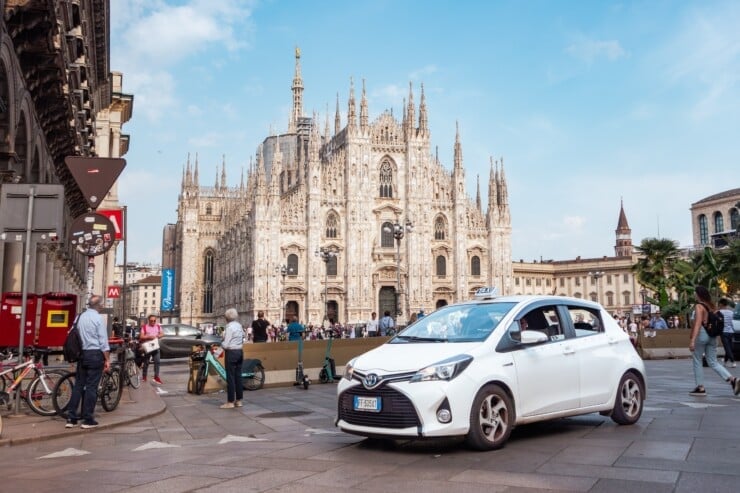
Our team of travel experts usually takes a taxi over a rideshare when in Italy. Taxis are easy to find at train stations, piazzas, and airports, but you don’t flag them in the street. Instead, go to a taxi stand or use apps like FREE NOW or itTaxi to book and pay digitally. In smaller towns, taxis and ridesharing options are highly limited. Plan or book private drivers for airport transfers or rural destinations.
Pros
- Convenient in urban centers and for late-night transfers
- Reliable and professional service in major cities
- App payments simplify the experience
Cons
- Limited availability outside main cities
- Higher fares during peak hours or events
- Some rural taxi services require advance booking
Things To Consider Before You Travel
When choosing how to travel around Italy, travelers should keep the following points in mind:
- Check for strikes (scioperi) affecting train services, bus routes, or flights.
- Combine modes of travel (e.g., train and car rental) for flexibility.
- Illegal cabbies may run scams in some ports or taxi stands, so only use accredited services.
- During the summer months, reserve transport well in advance.
- Limited mobility travelers are being better accommodated than in the past. However, it is still tricky to navigate Italy. If you need specific advice, don’t hesitate to contact us!
If you’re ready to start your Italy travel planning, explore our DIY Italy Itinerary Planner or read our guide to getting from Naples to the Amalfi Coast to continue your Italian adventure the Salt & Wind way.
Frequently Asked Questions About How To Get Around In Italy
Yes, though drivers should be alert and confident. Italian drivers can be assertive, and roads in historic areas are narrow. Avoid driving in city centers and always watch for ZTL and other road signs. Be prepared for traffic, confusion, and some level of stress while driving—it's even stressful for my Italian-born and-bred husband!
The high-speed train is the best option in my opinion and the only way I travel between those two cities. it takes about 90 minutes and departs frequently from Roma Termini to Firenze Santa Maria Novella stations. There are additional stations in Florence and Rome as well, so check the map for where you need to go before booking.
The fastest way to the major islands (e.g., Sicily and Sardinia) is by plane, though ferries are available for those who prefer to travel by sea. Flights between Rome or Naples and Catania and Palermo (Sicily) or Cagliari or Olbia (Sardinia) are frequent and affordable.
If you prefer ferry transport, you will need to decide which departure and arrival port makes the most sense for your trip, as each will have a few options. While helicopters are used to reach the island of Capri, almost all other smaller islands in Italy, from Ischia to Giglio to Lipari, are best reached by ferry.

Italian Expressions For Travel
No matter how you decide to get around Italy, learning a bit of Italian will go a long way. Check out our list of 105 basic Italian expressions to help you travel better!

Recipes Inspired By Italy
Not heading to Italy quite yet? Here are a few of our favorite classic Italian recipes to make at home to stoke your wanderlust:

Italy Travel Guide
Are you considering traveling to Italy in real life? Check out our complimentary Italy Travel Guide for our best travel tips, recipes, and articles.
Have Us Plan Your Italy Trip
Did you know we’re also a boutique travel agency specializing in Italy travel planning? If you’re looking to plan one of the best trips to Italy, our Italy vacation planner services are here to help you plan your perfect itinerary.
Photo Credit: Photos courtesy of Team Salt & Wind Travel, Shutterstock, and Unsplash