
🔑 Quick Answer: The Dolomites are a UNESCO-listed mountain range in northeastern Italy, spread across South Tyrol (Alto Adige), Trentino, the province of Belluno, and Friuli Venezia Giulia. The range has 18 peaks above 3,000 meters, with Marmolada the highest. Venice Marco Polo is the closest major airport, and most travelers base themselves in Val Gardena, Alta Badia, or Cortina d’Ampezzo.

Key Takeaways
- Your base decides the trip, because Val Gardena, Alta Badia, and Cortina d'Ampezzo are very different places.
- Hiking season generally runs from June through September and ski season from early December to early April, and many lifts, huts, and hotels close in between.
- The most famous spots, like Seceda, Tre Cime, and Lago di Braies, get crowded in summer and now take advance booking, while the quieter villages nearby are just as beautiful.
- A car gives you the most freedom, but a base in Bolzano with the Mobilcard pass gets you to Val Gardena without one.
The Dolomites are the crown jewel of alpine Europe, with jagged peaks rising over the valleys of Italy’s far northeast. Their landscapes are so dramatic that a single drive over a mountain pass can feel like the whole trip. As outdoor lovers, we’ve long adored it, and each year more and more of our travel clients ask about visiting for hut-to-hut hiking and ski season.
The catch is that the Dolomites aren’t one place and they’re not all equal. They’re a patchwork of valleys, each with its own language, food, and pace, and where you base yourself shapes the whole trip.
Between the Milano-Cortina Olympics and social media, the Dolomites are hardly unknown, so it’s more important than ever to find the right corner for you and your style (and to avoid crowds). This guide explains how the region fits together, who it suits, when to go, and where to stay.
Why Trust Us
I’m Aida Mollenkamp, founder of Salt & Wind Travel. I live in Mammoth Lakes, a ski town in California’s Eastern Sierra that’s often compared to the Alps, and have spent years working, traveling, and living in Italy. My love for the outdoors has taken me from the mountains of Piemonte to the Dolomites, and I love sharing what I find with our readers.
This guide is a group effort. We turned to travel photographer Jessica Wright of Bontraveler for her on-the-ground expertise. She traveled across the Dolomites for this guide, and she took every photo here.
Our planning team added what we’ve learned from years of sending couples, friends, and outdoor adventurers across the Dolomites. Our team has planned custom Italy trips for more than 10 years, and we send clients to the region every year.
We’re also building out ski trips by leveraging the relationships with ski guides, photographers, and other ski professionals we know personally and who have shared their expertise with us.
Best for: Couples planning their first Dolomites trip and families who want a valley with lifts and kids’ clubs right in town.

Getting Your Bearings On The Dolomites
The Dolomites are a mountain range in northeastern Italy, north of Venice and along the Austrian border. They span two main regions, Trentino-Alto Adige and the Veneto, with a small eastern corner in Friuli Venezia Giulia. Bolzano is the gateway city on the western side, and Cortina d’Ampezzo anchors the east.
Clients often come to us and say “the Dolomites” when they may, in fact, mean another area of the Italian Alps, so it’s key to clarify what they mean. And that also applies to terms for the area.
For example, South Tyrol is the English name for Alto Adige, the northern half of Trentino-Alto Adige, which belonged to Austria until after World War I. That’s why towns there have two names, like Bolzano and Bozen, and why German and Italian are both everyday languages. In a handful of valleys, including Val Gardena, Val Badia, and Val di Fassa, people also speak Ladin, an ancient Romance language.
This corner of Italy is so unique that UNESCO has protected the Dolomites as a World Heritage Site since 2009. The protected area covers nine mountain groups and more than 350,000 acres, with 18 peaks above 3,000 meters (about 9,800 feet). Marmolada is the highest, at 3,343 meters (10,968 feet).
Who Are The Dolomites Best For
After years of planning trips to Italy, we’ve found the Dolomites work for almost every kind of traveler, as long as you match the base to your travel style. Here’s where we send each of them.
- Couples: we usually point couples to Cortina d’Ampezzo or a resort in Alta Badia, and plan the days around easy hikes, long lunches, and spa time.
- Families: we often base families in Val Gardena, where lifts leave from town, and the Alpe di Siusi has gentle meadow trails for small legs.
- Groups of friends: we like Val Gardena or Cortina, with a guided hike or via ferrata by day and a lively town for dinner.
- Outdoor adventurers: we string together big hikes, via ferratas, and ski days, always with a local mountain guide for anything beyond a marked trail.
- Skiers: we start in Alta Badia, especially Corvara, right on the Sella Ronda ski loop.
- Travelers who don’t want to drive: we base them in Bolzano, where trains, buses, and cable cars reach the nearest Dolomites in Val Gardena.
Whoever you are, we aim to steer you toward the quieter valleys and villages, places rich in history and beautiful without being over the top, rather than racing between the famous viewpoints.
When To Go To The Dolomites
The Dolomites have two peak seasons: hiking from June through September and skiing from early December to early April. For fewer crowds, aim to hike in late June or September. For skiing, the snow is usually most reliable from January through March. Most of the trips we plan here run from late spring to early fall, and we usually steer clients to late June or September.
In between (say, October, November, and May), much of the region, including many lifts, huts, and hotels, closes. To add to the confusion, they don’t all close on one specific date, so you could be in one town with open restaurants and lifts and then find everything shut in the next town over. Check online resources and confirm hours before planning a shoulder-season trip.
| Season | Months | What's Open | Best For |
|---|---|---|---|
| Summer | June through September | Lifts, mountain huts, and high trails | Hiking, via ferratas, lakes, cable cars |
| Fall shoulder | Late September through November | Fewer lifts and huts; many hotels close; larches turn gold in mid to late October | Quiet valleys, Törggelen dinners, wine country |
| Ski season | Early December through early April | Dolomiti Superski lifts; snow most reliable January through March | Skiing, the Sella Ronda, après-ski |
| Spring shoulder | Mid-April through May | Many lifts, huts, and hotels close; high trails often still snowy | Bolzano, valley towns, wine country |
Where to Stay in the Dolomites
The best place to stay in the Dolomites depends on your trip. In other words, the best place to stay depends not just on who you’re traveling with, but also on your trip goals (hut-to-hut hiking or mellow meadow walks?), your budget, and when you’re traveling. Here’s how the main bases compare.
| Base | What It's Like | Best For |
|---|---|---|
| Val Gardena (Ortisei and Castelrotto) | Ladin and German-speaking, with walkable towns and lifts from the center | Families, first-timers, hikers |
| Alpe di Siusi | A high meadow above Val Gardena, largely closed to cars | Walkers who want to wake up on the plateau |
| Corvara, Alta Badia | A Ladin-speaking ski village on the Sella Ronda | Skiers and hikers |
| San Cassiano, Alta Badia | A quiet village known for serious dining | Couples who want a resort stay |
| Cortina d'Ampezzo | Italian-speaking and glamorous, with a real town center | Couples, shoppers, après-ski |
| Bolzano | A small city with wine country on its doorstep | Travelers without a car, culture and wine lovers |
For A First Trip To The Dolomites
Some of our clients want to day-trip into the Dolomites rather than commit a few days of their trip for their first visit. If that’s you, we suggest basing yourself in Bolzano and spending the day in Val Gardena.
Ortisei is the main town in Val Gardena and the closest part of the Dolomites to Bolzano. The center is very walkable, with the Parish Church of St. Ulrich on the main square, plenty of boutiques, and woodcarvings for sale all over town, since Ortisei is known as the capital of woodcarving. Two lifts leave from town, one up to the Alpe di Siusi and one toward Seceda.
A few minutes’ drive up the hill, Castelrotto is one of I Borghi più belli d’Italia, the most beautiful villages in Italy. For a second trip, consider quieter valleys like Val di Funes, Val di Fassa, and San Martino di Castrozza in Trentino.
How We Can Help
Picking the valley is easy. Lift schedules change by date, whole villages go quiet between seasons, and in high season the best hotels book out about six months in advance.
When we plan a Dolomites trip, we match you to the right valley and hotel for your dates, check which lifts and huts are running, and line up local guides for food tours, hikes, and ski days, plus drivers who know the passes. Start planning your Dolomites trip with us.
Getting to and Around the Dolomites
The easiest way to reach the Dolomites is to fly into Venice Marco Polo and rent a car there. Verona, Bolzano, and Innsbruck in Austria also work, depending on which side you’re visiting.
If you’d rather not drive, we base clients in Bolzano near the old town, not by the train station, and have them use the Mobilcard, which covers regional trains, buses, funiculars, and cable cars. The südtirolmobil app has timetables and tickets. For Ortisei, take the train to Ponte Gardena or Chiusa, then the bus up the valley. On the Veneto side, ATVO runs direct buses between Venice and Cortina.

Things To Do In The Dolomites
The best things to do in the Dolomites happen outdoors, and most end with a long lunch. These are the days we build trips around.
Hike to a Rifugio
Trails for every level exist here, and many start at the top of a lift, so you get big views without the big climb. Families love the gentle meadow walks on the Alpe di Siusi. Stronger hikers should do the loop around Tre Cime di Lavaredo or the ridge at Seceda. Either way, time it so you reach a rifugio (one of the mountain huts) in time for lunch.
Ride the Lifts
You don’t have to hike to get up high. Lifts leave right from Ortisei and Cortina d’Ampezzo, so non-hikers can still eat lunch above the tree line.
Climb a Via Ferrata With a Guide
Via ferratas are climbing routes fitted with iron cables and ladders, and the Dolomites are famous for them. Several around Cortina follow World War I front lines, and the tunnels at Lagazuoi and the open-air museum at Cinque Torri tell that story. The weather changes fast up here, so start with a mountain guide. We pair clients with local guides for anything beyond a marked trail or groomed run.
Ski the Sella Ronda
The Dolomiti Superski pass covers 12 ski areas and about 1,200 kilometers of slopes. The signature day is the Sella Ronda, a loop around the Sella massif that links Val Gardena, Alta Badia, Arabba, and Val di Fassa. Italian law requires a helmet for every skier, plus third-party liability insurance you can buy with your lift pass. Off-piste, you must carry a transceiver, shovel, and probe, so go with a guide.
Drive the Passes
A road trip is the best way to string the valleys together, over high passes and past castles and hilltop villages. Pick up the car in Venice, and plan for slow going on the hairpin turns. Some passes now limit day-trip traffic in summer, so check the road rules before you set your route.
Eat and Drink Like a Local
The Dolomites sit where Italy meets the Austrian Tyrol, so the food is Alpine first: dumplings, speck, and apple strudel alongside pasta and polenta. Meals run earlier than in the rest of Italy, too. Around Bolzano, dinner can start at 6 p.m., and many restaurants close on Sunday and Monday.
To drink, look for Trentodoc sparkling wine, crisp Alto Adige whites like Pinot Bianco and Gewürztraminer, and Lagrein, the local red. In autumn, Törggelen season brings farmhouse dinners with new wine and roasted chestnuts. Our Dolomites food guide has the dishes to order.
Watch the Peaks Turn Pink
At sunrise and sunset, the pale rock glows pink, a light the Ladin call enrosadira. It’s the moment that makes the Dolomites feel like nowhere else, and the Fassa Valley is one of the best places to catch it.

How to Avoid the Crowds
A few famous spots, like Seceda, Tre Cime, and Lago di Braies, draw most of the summer crowds, but the rest of the Dolomites stays surprisingly quiet. Here’s how we keep our clients’ days calm and light in the mountains.
- Go in June or September, when the trails are open and the crowds have thinned.
- Book the Tre Cime toll road and Lago di Braies parking ahead, reserve a Seceda time slot, and go early or late.
- Trade one famous stop for a quieter one, like Castelrotto, Corvara, or Val di Funes.
- Stay a few nights in one valley, and use the südtirolmobil app and the Mobilcard for trains, buses, and lifts.
- Stay on marked trails, especially across the Alpe di Siusi, whose meadows are working farmland.
Frequently Asked Questions About The Dolomites
The Dolomites are a mountain range in northeastern Italy, known for dramatic cliffs, vertical walls, and idyllic alpine valleys. They became a UNESCO World Heritage Site in 2009, and 18 of their peaks rise above 3,000 meters.
The Dolomites are in Italy's far northeast, near the Austrian border, across South Tyrol, Trentino, the Veneto, and Friuli Venezia Giulia. Bolzano is the main gateway city on the western side, and Cortina d'Ampezzo is the best-known town in the east.
Venice Marco Polo is the closest major airport and the easiest place to pick up a rental car. Verona, Bolzano, and Innsbruck in Austria are good alternatives, depending on which side of the range you're visiting.
Visit from June through September for hiking, when most trails are clear and the huts and lifts are running. For skiing, the season runs from early December to early April. Spring and late fall are quieter, but many lifts, huts, and hotels close.
Stay in Val Gardena for easy access from Bolzano and lifts in town, Alta Badia for a quieter resort stay, or Cortina d'Ampezzo for an Italian-speaking town with shops and restaurants. The Alpe di Siusi suits walkers who want to wake up on the plateau.
In summer, yes. The toll road to Rifugio Auronzo at Tre Cime and daytime access to Lago di Braies now require advance booking, and the Seceda cable car operates on bookable time slots. Check the official sites before you go, since the rules change each year.
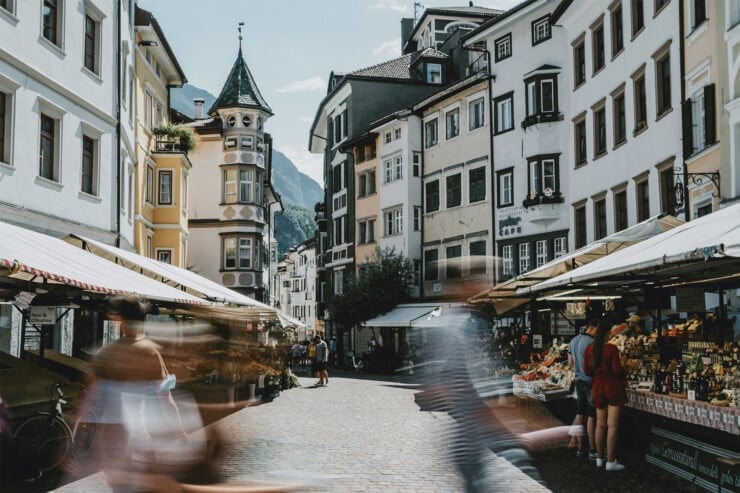
Bolzano Italy Travel Guide
As you explore the breathtaking landscapes of the Italian Dolomites, be sure not to miss the opportunity to visit Bolzano, a town that perfectly encapsulates the region’s unique blend of culture and natural beauty. Known for its fascinating mix of Italian and Austrian influences, Bolzano offers something for every traveler—from medieval castles and vibrant markets to world-class vineyards and museums.

Classic Italian Recipes
When you return from the Dolomites, these dishes bring the mountains home.
Italy Travel Guide
Are you considering traveling to Italy in real life? Check out our free Italy Travel Guide for our best travel tips, recipes, and articles.
Have Us Plan Your Italy Trip
Did you know we’re also a boutique travel agency specializing in Italy travel planning? If you’re looking to plan one of the best trips to Italy, our Italy trip planner services are here to help you plan your perfect itinerary.
Photo Credit: All photos by Jessica Wright
