
🔑 Quick Answer: The wine tasting tips that matter most are simple. Book ahead, keep it to two or three wineries a day, hold the glass by the stem, use the spit bucket, and skip the perfume. What to wear, what to tip, and when to start all follow from those five, and the 25 below fill in the rest.
Key Takeaways
- Two or three wineries a day is the ceiling, and two is better. The third tasting is the one nobody remembers.
- Book ahead in Napa, Sonoma, Santa Barbara, and Paso Robles, where most rooms now require a reservation. Mendocino, Monterey, and the Sierra Foothills still take walk-ins.
- Tasting rooms close by 5:00 PM and sometimes 4:30, earlier than almost anything else in California, and many wineries close Monday and Tuesday.
- Budget $20 to $100 or more per person per tasting, and tip $10 to $20 per couple on anything seated or private.
Wine-tasting tips are worth more from someone who’s done it badly first. I have turned up at a closed tasting room, booked four wineries in a day and remembered two, and once wore perfume to a barrel tasting, which I did not do twice.
California is the easiest place in the world to taste wine and a surprisingly easy place to waste a day. Here are 25 things that make the difference, in the order you will need them. Most of them travel: if you’re traveling to France, our guide to wine tasting in France covers where the etiquette differs.

Why Listen to Me
I have been tasting my way through California wine country for over a decade. Napa and Sonoma first, then Paso Robles once the Rhône producers there got interesting, and lately Mendocino and the Sierra Foothills for clients who want somewhere quieter. I have tasted at more than 100 California wineries.
I hold a WSET Level 2 certification in wine, trained as a chef at Le Cordon Bleu, and lived in San Francisco for almost 10 years. Behind me is Salt & Wind Travel, which I founded in 2014 and which has planned more than 50 California wine trips. We arrange vineyard tours and private tastings for clients across Sonoma, Santa Barbara, Mendocino, and Monterey, so the tips below aren’t just theory. They are what I say on the phone before somebody’s first day out.


The 25 Wine Tasting Tips
The 25 run in the order you will need them: five before you leave, five in the room, five about the people in it, five about where to go, and five about getting more out of the day.
Before You Go
These five decide whether the day works, and they all happen before you leave the hotel.
1. Book ahead in Napa, Sonoma, Santa Barbara, and Paso Robles. Most tasting rooms in those four now require a reservation, and weekends fill two to three weeks out.
2. Cap it at three wineries a day, and two if you want lunch to be more than a sandwich in the car. This is the correction we make most often to a client’s draft itinerary.
3. Sort your driver before you sort your tastings. Designated driver, car service, or guided tour: decide first, because it changes how far apart your wineries can be. A private guide with a vehicle ran our clients $700 for an eight-hour day in September 2026.
4. Check the day of the week. Many wineries and small-town restaurants close Monday and Tuesday, and in a small town that can mean the one good restaurant is dark too.
5. Eat a real breakfast. Tastings start around 10:00 AM and the first pour is rarely small.
In the Tasting Room
These five are the mechanics. They are what “knowing how to taste” actually means, and none of them takes longer than a few seconds.
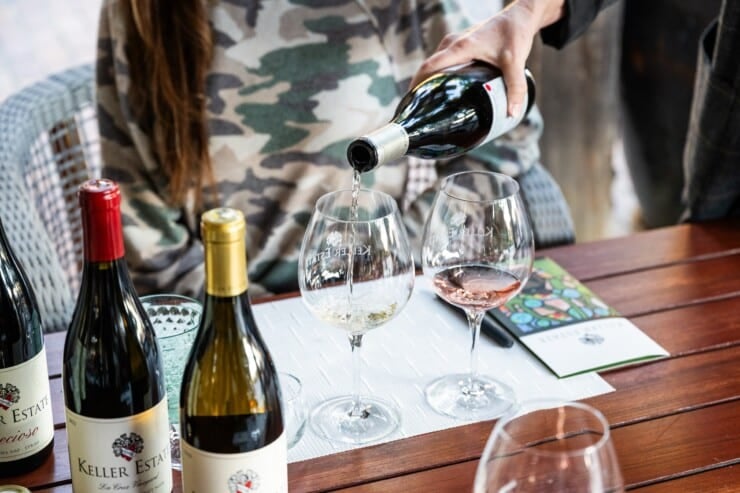
6. Hold the glass by the stem or the base. Your hand warms the wine through the bowl and changes how it tastes.
7. Tilt the glass over something white and look first. Depth and rim color tell you about age and grape before you have smelled anything.
8. Swirl, then smell twice. Once briefly, once properly. The second one is where the detail is, and where secondary aromas like spice and oak turn up.
9. Take a small sip and let it sit on your tongue. You are looking for acidity, tannin, and alcohol, and for whether they balance each other.
10. Notice the finish. A flavor that lasts is one of the few quality markers that holds at every price point.

Etiquette
These five are about the room and the people in it, and they are the ones that change how you get treated.
11. Use the spit bucket. It is what the professionals do, and it is the only way to taste 12 wines and still remember the fourth.
12. Ask questions. “What is the elevation here?” or “when did you pick?” will get you a better pour than any amount of nodding.
13. Skip the perfume, the scented lotion, and the hairspray. You will not smell the wine, and neither will anyone standing near you.
14. Tip on anything seated or private. Ten to 20 dollars per couple is standard in California.
15. If you love something, buy a bottle. It is how small producers stay open, and the fee is often waived when you do.

Choosing Where to Go
These five are the planning decisions, and they matter more than any of the tasting mechanics above.
16. Match the region to the day you want. Napa, Sonoma, Santa Barbara, and Santa Ynez are structured and usually seated. Paso Robles, Monterey, Mendocino, Temecula, and the Sierra Foothills are more casual and still take walk-ins. Our full comparison is in the California wine regions guide.
17. Go on a weekday if you possibly can. The same tasting room is a different experience on a Tuesday.
18. Pick one area and stay in it. Napa is 30 miles long, and the drive from Carneros to Calistoga eats an hour you were going to spend tasting.
19. Look for wineries making something you cannot buy at home. Sinor-LaVallee grows its fruit just over a mile from the Pacific on the San Luis Obispo coast, and New Clairvaux is a working Trappist abbey up in Tehama County. Neither is on a shelf in your city, which is the whole argument for being there.
20. Build in one thing that is not wine. A farm tour, a u-pick orchard, or a stop on the Sonoma cheese trail. It resets your palate and it is usually what people describe first when they get home.

Getting More Out of It
These five are the difference between a nice day and one that teaches you something.
21. Take notes. An app or a notebook, either beats trying to remember on the drive home.
22. Taste the same grape at two wineries in a row. Nothing teaches terroir faster. Merry Edwards in the Russian River Valley next to almost any other Sonoma Pinot Noir makes the point in about 20 minutes.
23. Ask what they drink. Tasting room staff and winemakers will nearly always tell you, and it is usually not the flagship.
24. Try one wine you expect not to like. Most people who think they do not like wine have met three of them, all of the same kind, usually warm. Rosé and Riesling are where that assumption most often falls apart.
25. Book the last tasting of the day at the place you most want to linger. Nobody is rushing you out, and the light is better. Just remember that tasting rooms close by 5:00 PM and sometimes 4:30, so the last slot is earlier than you think.
Where to Taste, by Region
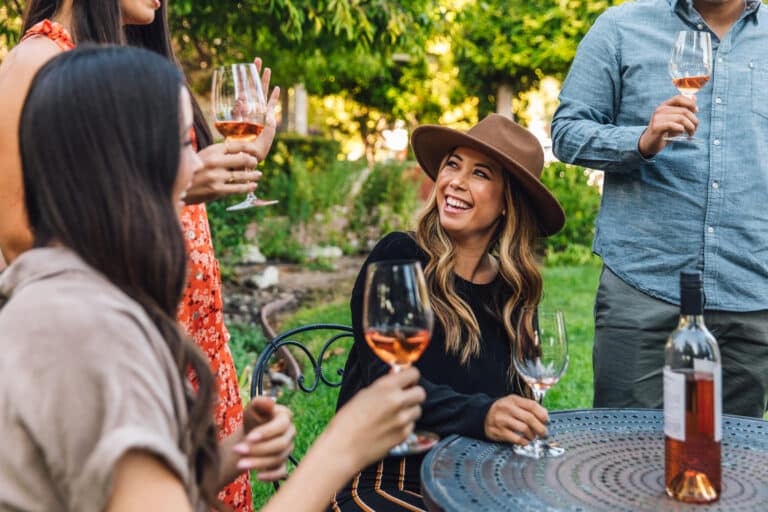
California’s regions differ less in quality than in how they pour, and that is the thing to match to the day you want. They run below from the most structured to the most casual, so the further down you read, the more likely you are to be able to turn up without an appointment.
| Region | Reservations | Walk-ins | The feel | Best for |
|---|---|---|---|---|
| Napa Valley | Required at most estates | Rare | Structured, seated, often paired with food | A milestone trip |
| Sonoma County | Usually required | Some | Polished to barn-casual, depending where | A full week |
| Santa Barbara and Santa Ynez | Usually required | Yes, in the Funk Zone | Relaxed but organized | Tasting without a car |
| Paso Robles | Recommended at the best-known | Common | Casual and conversational, Rhône-focused | Turning up and talking |
| Monterey and Santa Lucia Highlands | Recommended | Common | Quiet and under-visited | Avoiding crowds |
| Mendocino | Rarely required | Yes | Small, rural, organic-leaning | A road trip |
| Sierra Foothills | Rarely required | Yes | Gold-country informal, old-vine Zinfandel | Pairing with Yosemite |
| Temecula | Recommended at weekends | Yes midweek | Resort-style, the busiest southern region | A weekend from San Diego |
What Wine Tasting in California Costs
Here is what our clients actually paid in September 2026, for a week across Sonoma, Napa, and Santa Barbara.
| What | Real quoted cost | Where |
|---|---|---|
| Tasting at a small family winery | $40 per person | Dry Creek Valley, Sonoma |
| Tasting hosted by the owner, with food | $95 per person | Dry Creek Valley, Sonoma |
| Cave tour and sparkling tasting | $100 per person | Calistoga, Napa |
| Wine and food pairing with lunch | $185 per person | Napa Valley |
| Private guide and vehicle, full day | $700 | Sonoma and Napa, eight hours |
| Private car, SFO to Healdsburg | $645 | About two hours |
As a general range, budget $20 to $ 100+ per person per tasting, and $40 to $150 in the better-known rooms. Fees are often waived with a purchase, which changes the arithmetic if you were going to buy a bottle anyway. Tip $10 to $20 per couple on anything seated or private.
If you would rather not assemble the day yourself, book a complimentary Discovery Call, and a Salt & Wind planner will build the wine country week around what you actually like drinking.
Frequently Asked Questions About Wine Tasting Tips
Two or three. Factor in drive time, a real lunch, and time to linger, and the third tasting is usually the one nobody remembers.
Tasting fees run $20 to $100 or more per person, and $40 to $150 in the better-known rooms. They often waive fees if you buy a bottle or join the wine club. A private guide with a vehicle runs about $700 for an eight-hour day.
Yes, for anything seated or private. In California, $10 to $ 20 per couple is standard.
Spit, if you are visiting more than one winery or driving at any point. It keeps your palate sharp, and it is what the professionals do.
Wear layers, comfortable shoes, and avoid strong scents. Outdoor tastings are common in spring and summer, so bring sun protection.
Around 10:00 AM, with a long lunch built in. Remember that tasting rooms close by 5:00 PM and sometimes at 4:30, so the day is shorter than it looks.
Rarely in California, but they often waive fees with a purchase. It is always worth asking politely.
Paso Robles, Monterey, Mendocino, Temecula, and the Sierra Foothills. All five still take walk-ins, and personal preference often matters more than scores.
In Napa, Sonoma, Santa Barbara, and Paso Robles, usually yes, especially at weekends. Mendocino, Monterey, and the Sierra Foothills often take walk-ins, though booking ahead is still the safer move.
Eat before you taste, drink water, skip the perfume, and stick to two or three wineries. Use the spit bucket and ask questions. Those six cover most of it.
Usually because of a small and unrepresentative sample. Most people who think they dislike wine have met a handful of the same style, often served too warm, often at a party rather than at a table with food. Temperature alone changes a wine enormously, and a cold, high-acid white with something salty is a different experience from a warm red in a plastic cup. Try one wine you expect not to like, properly chilled and with food, before deciding.
Yes, and this is what the spit bucket is for. A tasting pour is about an ounce, and if you spit, you can taste a dozen wines across a day and stay well under a drink. Nobody in a tasting room will think anything of it.
Food And Wine Pairing Tips
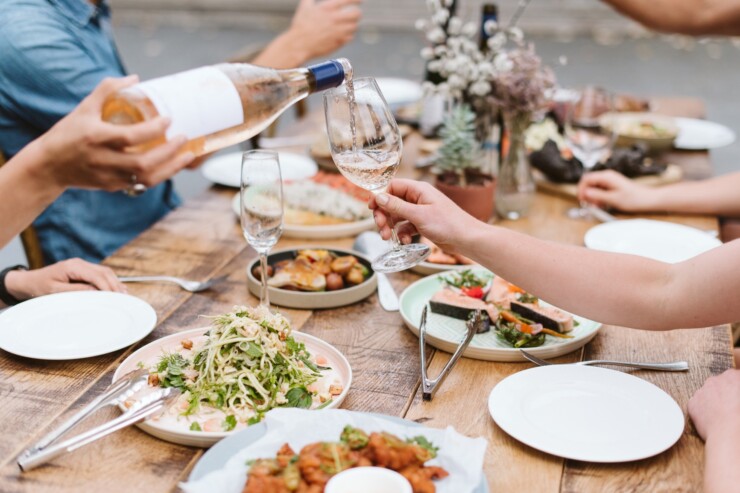
Not heading wine tasting soon? If you’re hosting a dinner party with wine, you may want to check out these food and wine pairing tips instead!

Healthy California-Inspired Recipes
Here are a few recipes inspired by our home state of California:

California Wine Country Travel Guide
Thinking about visiting a wine region in the Golden State? You’ll want to check out our California Wine Country Travel Guide for travel tips, itinerary ideas, and more California-inspired recipes.
Have Us Plan Your Trip
Did you know we’re also a boutique travel agency specializing in California vacation planning? If you’re looking to plan a wine country or road trip to California, our California trip planner services are here to help you plan your perfect itinerary.
Photo Credit: All photos by James Collier of Paprika Studios, Hilary Rance, or Team Salt & Wind Travel courtesy of California Grown


