
🔑 Quick Answer: The best cheese board ideas start with restraint: buy an odd number of cheeses at different ages, plan on one to two ounces of each per person, and take everything out of the fridge 30 minutes before you serve. Give every cheese its own knife, and leave the gaps deliberate.

Key Takeaways
- An odd number of cheeses at different ages gives you a board that reads as deliberate, and three to five covers most gatherings.
- You need one to two ounces of each cheese per person, which is less than most people buy.
- Cheese tastes better warm, so take it out of the fridge 30 minutes before you serve it.
- Every cheese gets its own knife, so that the blue doesn't end up in the brie.
Cheese board ideas are easy to collect and hard to execute, and the difference is usually four decisions you make before you leave the shop. We have built boards for live events, for charity dinners, and for more nights at home than we can count, and the same eight come up every time.
None of them is about styling. They are about which cheeses you buy, how much you buy, how you cut them, and what you put in the gaps.
Why Trust Us
I’m Aida Mollenkamp, a Le Cordon Bleu-trained chef, and I ran the professional test kitchen as Food Editor at CHOW magazine. I also hold WSET Level 2 in wine, which is where the pairing advice below comes from.
These eight tips came from building boards for our own live events and charity dinners, not from a styling guide. At Salt & Wind Travel, we plan food-focused trips through California, France, Italy, Spain, and Switzerland, and we regularly include cheesemakers, markets, and tastings in those itineraries.
Cheese counters vary, and so does what is in season, so treat the quantities below as a starting point and ask your cheesemonger.
Best for: friend groups and families; food & wine lovers; special occasions
How To Make A Cheese Board, Step By Step
You make a cheese board in three moves: buy the right amount, cut each cheese to suit its texture, and arrange it so guests can tell what goes with what.
How Much Cheese To Buy
You almost certainly need less cheese than you think, and the number depends on whether the board is the meal or the opener. Plan on one to two ounces of each cheese per person. Three cheeses are enough when the board opens the evening. Go to five when the cheese is dinner.
| Guests | Cheese as the opener (3 cheeses) | Cheese as the meal (5 cheeses) |
|---|---|---|
| 4 | 12 to 24 oz | 20 to 40 oz |
| 6 | 18 to 36 oz | 30 to 60 oz |
| 8 | 24 to 48 oz | 40 to 80 oz |
| 12 | 36 to 72 oz | 60 to 120 oz |
How To Cut Each Cheese
Each cheese wants a different cut, and getting this right does more for a board than any amount of arranging.
- Soft cheeses like Brie are served whole, with a knife beside them, so guests serve themselves.
- Medium-firm cheeses like young Manchego get sliced before the guests arrive.
- Hard-aged cheeses like Parmigiano Reggiano are broken into chunks rather than sliced.
- Serve each cheese with about two-thirds of it already cut, so guests can both eat it easily and tell what it is.
Give every cheese its own knife. Guests will use whatever is nearest, and one shared blade puts blue into the brie within minutes.

How To Arrange The Board
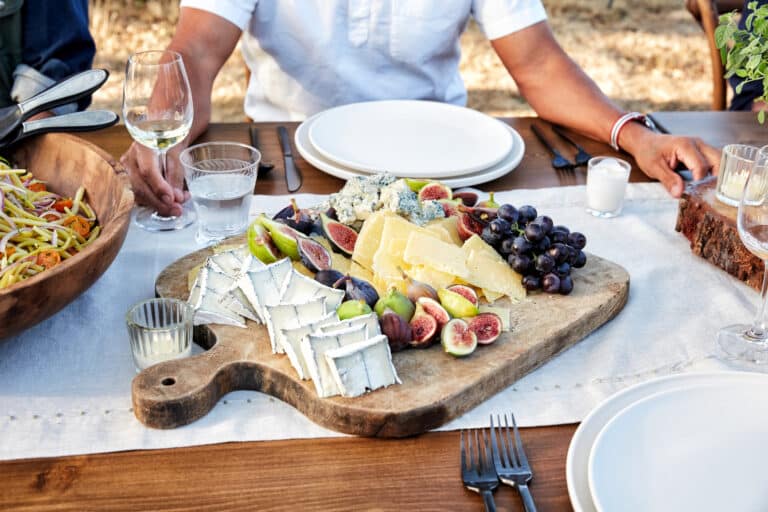
Put the cheeses down first, spacing them so each one has room. Then set the accompaniments that belong with each cheese nearby, so a guest can see what goes with what. Fill the remaining gaps with fruit and nuts last.
When To Take The Cheese Out Of The Fridge
Cold cheese tastes like almost nothing, so the last step happens before the doorbell does.
Bring every cheese out of the refrigerator about 30 minutes before you serve it. Firm and aged cheeses need the full half hour to open up. Fresh cheeses can go out closer to the end, because they warm faster and soften quickly in a warm room.

Cheese Board Ideas That Work Every Time
The four steps above cover the mechanics. These eight cheese board ideas are the judgment calls that separate a board people pick at from one that disappears.
Have A Loose Theme
Let’s establish some ground rules, shall we? First things first, you do not have to be super literal about your theme. As in, if you want some Spanish cheeses, it doesn’t have to be only Spanish cheeses.
Of course, if that’s what you want to do, go for it. If you were running with the Spanish theme, we’d suggest some Manchego and Mahon cheeses, a few Marcona almonds, some quince paste, and olives, by the way. But don’t feel obligated to have a hard-and-fast “theme.”
Instead, opt for a loose theme that serves as an organizing principle. This will make it easier to hone in on flavors for your cheese board, and it will also help you make sure flavors aren’t so all over the place that it becomes a free-for-all.
A few classic ways to organize the cheese board are by type of cheese (say, all goat’s-milk cheeses), by geographic region (all California cheeses), or by time of year (summer). Let it evolve naturally, so if you see something delicious that doesn’t quite fit, you can still add it to the cheeseboard.

Choose A Mix Of Flavors
Now that you know where to start with your cheese board ideas, let’s talk about flavor combinations. The easiest way to think about it is to consider that you can have complementary or contrasting flavors. But that’s oversimplifying it. Because once you consider that those flavors could be sweet, salty, spicy, sour, or have umami, well, the combinations become numerous.
Our take is that you should pair contrasting flavors only when a cheese plate has a single cheese. That way you can make sure all those flavors contrast (in a good way) with the cheese.
In other words, if you’re making a cheese platter with a variety of cheeses (as we have here), it’s best to use complementary flavors. That way, no matter which flavors your guests pair, they should be pleasing to their taste buds!
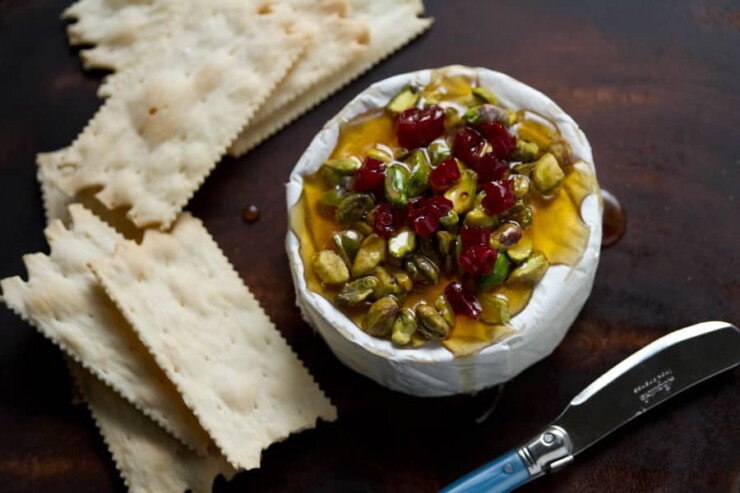
Also Choose A Mix Of Cheeses
One old-school cheese board tip that we totally stand by? That your cheese board should have a mix of cheese types. Sure, we could tell you all the rules out there, but that’d be a lot to memorize.
Our advice is to have an odd number of cheeses and to mix in different ages of cheese (something fresh like burrata, something semi-aged like brie, something super-aged like Gouda), and, if you like it, blue cheese.
Finally, not to shirk responsibility, but we highly recommend you go to your local cheese store and ask for their advice. Tell them the type of event you’re planning, whether the cheese is part of a bigger meal or the main course, and the types of cheeses you like. Then they’ll be able to recommend which cheese they sell that will work together because the bottom line is they’ll know best.
P.S. If you want to dive deeper into all things cheese, check out our guide to famous Italian cheeses
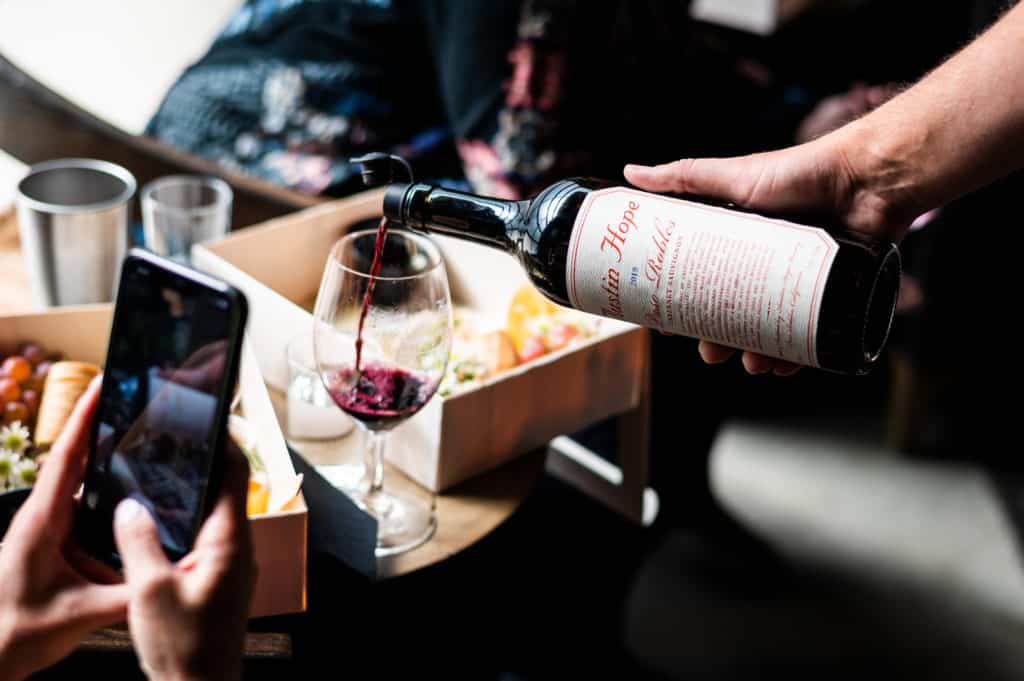
Match The Sips To The Bites
You put real effort into the board, so the wine deserves the same attention. Cheese board pairing comes down to quality on both sides.
If you want one wine that works across a mixed board, pour a good sparkling wine, a French-style Chardonnay, a classic Sauvignon Blanc, a bolder rosé, or a dessert wine when sweet flavors are involved.
We go much deeper on which wine goes with which cheese in our guide to hosting a cheese and wine party, and our food and wine pairing guide covers the method if you want to work it out yourself.
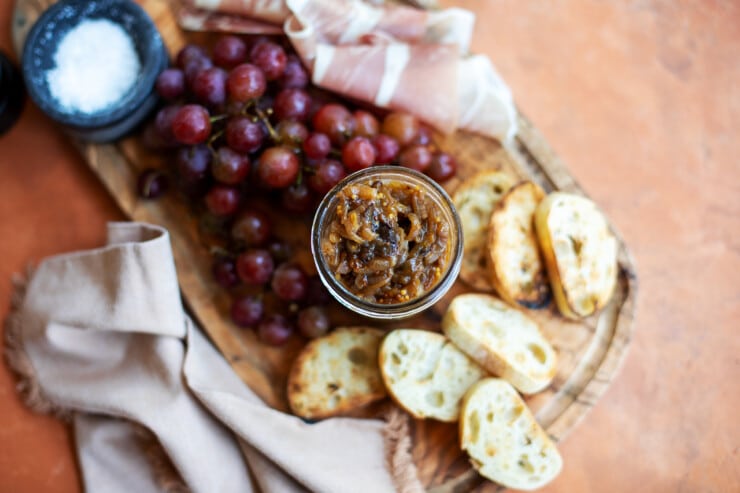
Add A Mix Of Dried And Fresh Fruit
To us, a cheese board isn’t really a cheese board until some fruit gets involved. When we have time, we go to our local farmers market and buy a mix of fresh and dried fruit.
If we don’t have time, Trader Joe’s is our go-to for dried fruit because they have a huge variety from the expected (dates, figs, and apricots) to the unexpected (dried orange slices).
Just as critical as fruit are some great nuts, of which, again, Trader Joe’s has a good assortment. Go with at least three different types, including a simple roasted, salted nut, one that’s flavored (say rosemary or truffle or chile), and one that’s in-shell. We know the last one isn’t a need-to-have, but there’s something about guests having something to do with their food that makes a party even more fun.
Go For A Variety Of Textures
While you’re at it, make sure your cheeseboard has a mix of textures from crackers to cheese to jam. Tbh, this will probably just naturally happen as you buy the elements of the cheeseboard, but just gut-check yourself before you start building the board.
Let’s be real — so long as they’re something crunchy to pair with all that cheese, most people will be happy!
(And why we like adding in things like Shallot Prune Jam or this Grape Agrodolce.)
Add In A Conversation Starter
Maybe it’s a fruit salsa you found at your local gourmet store, a chocolate bar you brought back from your last trip, or a homemade cracker, but adding something unexpected to the cheeseboard acts as a sort of icebreaker and gets people talking. (Something especially helpful when you’re throwing an event where not all the guests have met before.)

Make It Easy To Eat, Not Just Pretty
Think through how the board looks, then check that it still works. A board that photographs well and falls apart the moment someone reaches for the brie has failed at its actual job. Leave a clear route to every cheese, keep the knives where they belong, and put the crackers somewhere a guest can reach without leaning across the table.
What else to put out
A cheese board rarely goes out alone. If you are building a longer table, our cocktail party appetizers collection covers what else to serve alongside it.
Frequently Asked Questions
Start with three to five cheeses at different ages and textures, then add one or two cured meats, something sweet like fig jam or honey, fresh and dried fruit, a few kinds of nuts, and at least one crunchy thing such as crackers or a flatbread. Leave the gaps deliberate rather than packing every inch.
Plan on one to two ounces of each cheese per person. For a board that opens the evening, three cheeses for six people comes to roughly 18 to 36 ounces total. When the cheese is the meal, go to five cheeses and expect to double that.
Pick an odd number and vary the age and the milk. A fresh cheese like burrata, a semi-aged one like brie, and a hard, aged one like Gouda cover the range, and blue is worth adding if your guests like it. Tell your cheesemonger what else is on the menu and how many people are coming, and let them steer the rest.
Cut and arrange the cheeses up to two hours ahead, then cover the board loosely and leave it on the counter rather than in the fridge. Add crackers, fresh fruit, and anything that goes soggy in the last 10 minutes.
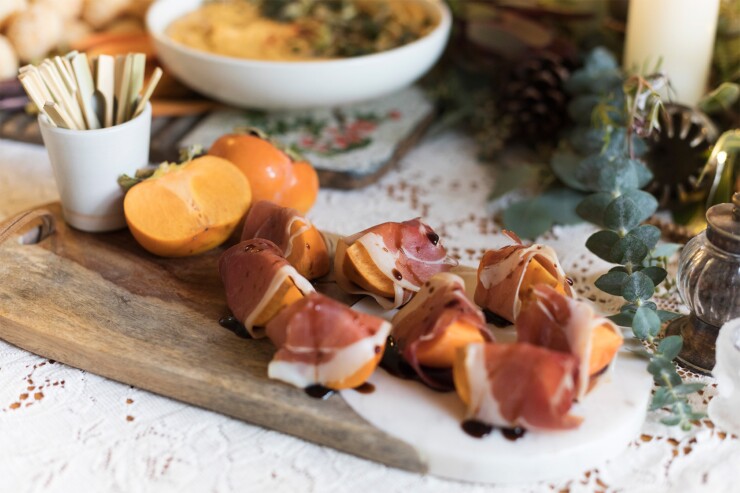
Other Flavors To Add To Your Cheeseboard
Here are some quick homemade flavors you can add to your cheese board:
Plan A Trip Around The Cheese
You now know how to make a cheese board that works at home. If you want to taste it at the source, we build visits to cheesemakers, markets, and tastings into the food-focused trips we plan through California, France, Italy, Spain, and Switzerland.
See our culinary travel services, or tell us about your trip, and we will map it out for you.

California Road Trip Travel Guide
Thinking about taking a road trip in the Golden State? You’ll want to check out our California Road Trip Travel Guide for travel tips, itinerary ideas, and more California-inspired recipes.
Have Us Plan Your California Trip
Did you know we’re also a boutique travel agency specializing in California vacation planning? If you’re planning a trip to California, our California vacation planning services can help you create your perfect itinerary.
